
Uretamendi, December 2023. Border between houses and gardens.
The IntegrateNbS project kicked off in January 2024. Funded by the Driving Urban Transitions partnership, the project aims to explore the ‘transformative potential’ of so-called nature based solutions (NbS) in urban planning. We work with the 3 Spheres for Transformation framework proposed by Karen O’Brian and Monica Sharma and count with the support of cChange as consulters expanding the application of this framework worldwide through their succesful Transformative Leadership for Sustainability program.
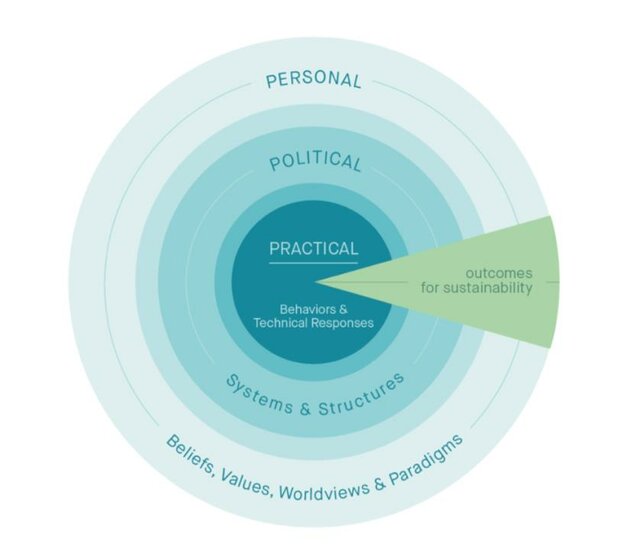
In a nutshell, the 3 Spheres framework considers that for sustainability transformations to be effective, they need to happen at three interconnected levels: the practical interventions in the world, at institutional systems and structures and in peoples values, beliefs systems and worldviews. From this lens, a practical intervention like a NbS could be more transformative if changes are induced in the institutions and policies planning for it and in the values of people affecting and affected by it.
IntegrateNbS aims to contribute to an identified knowledge gap concerning the consideration of social dimensions, such as equity and justice, in the design and implementation of NbS. Its main output will be a co-creative methodology, the ‘IntegrativeLabs’, to include such dimensions when developing NbS. We have 6 case studies in 4 European countries (Norway, Sweden, Poland and Spain) in which we will test this methodology to accompany existing NbS planning processes.
What I really like from this process is having cChange as internal coachers helping as build a solid foundation for an interdisciplinar and intercultural collaboration. We have internally applied the 3 Spheres framework to organise ourselves as a team. We will also apply it as the baseline for designing the Integrative Labs. I dont often work from pre-defined frameworks but I see value in this heuristics that is sufficiently simple to give room to diversity, while sufficiently complex to enable collective comprehensive thinking.
The Spanish team at the Basque Center for Climate Change is working with two case studies. First, in a pheripheral neighbourhood in Bilbao, Uretamendi, self-constructed by migrants that came from other parts of Spain to work in the industries during the 50-60s. It is literally a village carve up in the mountain, an ecotone between the urban and the forest (see pic at the beginning of the post). Our research in Uretamendi will focus on understading how people relate to nature in the area and how this can inform local council plans for renaturalization.
Second, we are working with the EbroResilience Strategy, a large scale policy initiative involving 5 public administrations to transform flood risk governance in the middle Ebro river. EbroResilience has been implementing NbS for the last 5 years as a new way of co-habiting with the river rather than attempting to control it. Yet, this shift to NbS has triggered strong confrontation and conflicts that are being attended through an ambitious participatory and conflict transformation program. The work with EbroResilience will be a collaboration to developing an evaluation framework and assess the transformative potential of their participatory strategy, a framework that will be later applied to the other case studies.
 Violeta Cabello