Categories
Mar Menor socionatures

Social-Ecological Affective Arrangements: diving with a small sea of many seas

Understanding Our Affective Connections to the Mar Menor

I am thrilled to share my latest preprint, Socialecological affective arrangements: diving with a small sea of many seas,” now available on the PhilSci-Archive, and under review in Nature Social Sciences and Humanities Communications.

This work represents a deeply personal and academic journey into the heart of the Mar Menor in Southeastern Spain. As many of you know, this saltwater lagoon has faced devastating ecological crises, from microalgae turning the water green in 2015 to mass fish die-offs in 2019 and 2021 due to eutrophication. As I analysed in depth in a previous work, eutrophic crises triggered an important sociopolitical conflict in the region, gradually leading to deep seated divisions between coastal and agricultural communities. Yet, amidst this degradation, the Mar Menor has also become a global milestone as the first ecosystem in Europe to be granted legal personhood.

Why “Affective Arrangements”?

In sustainability science, we often reduce environmental problems to scientific facts and reports. While crucial, these “facts” often overlook how we actually feel and experience our ecosystems, how we develop our identities in relation to them.

In this paper, my co-authors and I explore the concept of Social-Ecological Affective Arrangements (SEAA). We draw on the work of philosopher Jan Slaby & colleagues, in particular their notion of affective arrangements. With them, we argue that emotions like grief, rage, or hope are not just internal feelings; they are ways of relating people, things, spaces, and practices that mutually affect one another. We also take their distinction between affects and emotions as valuable for socialecological relational analysis, considering socialecological processes as affective.

The Mapparatus: Visualizing the Invisible

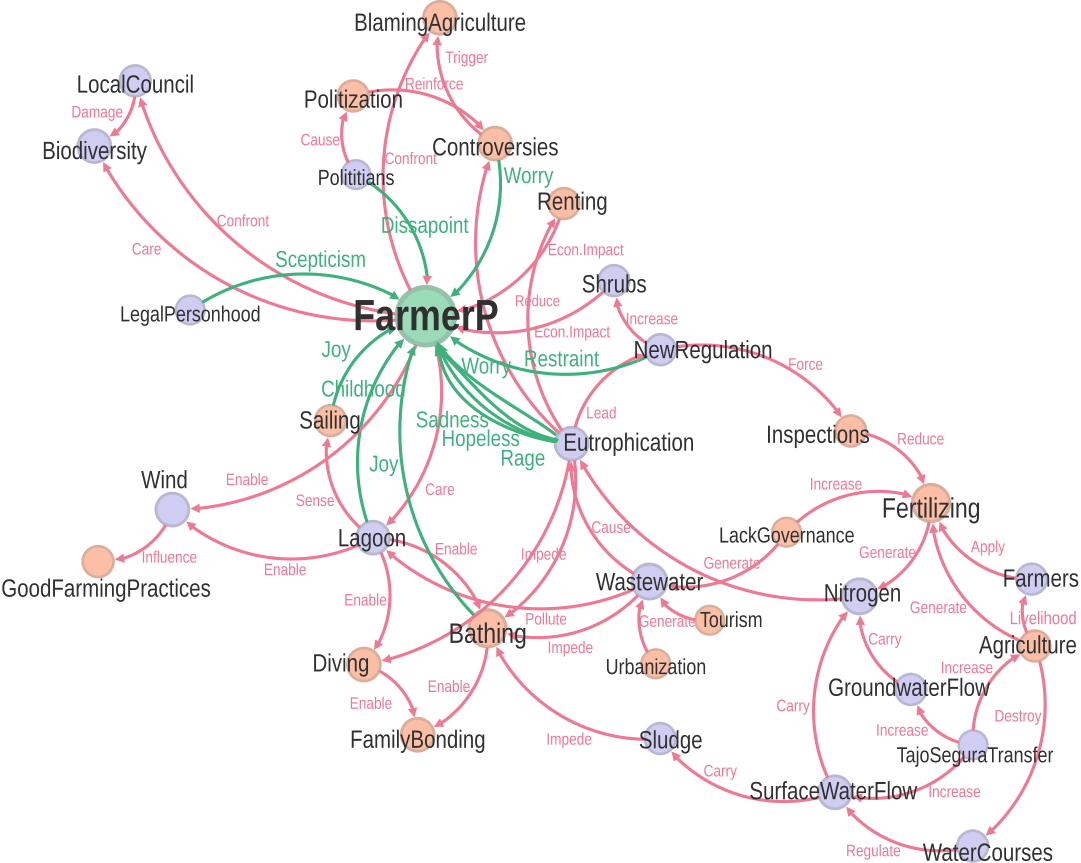
To bring this theory to life, we developed a methodology we call a “mapparatus”. By conducting relational interviews with local actors in the Mar Menor—including farmers, fishers, and biologists—we extracted the affective structures of their lived experiences and coded them into a network dataset.

We used network analysis to visualize these “SEAAs,” showing how, for instance, childhood memories of swimming are inextricably entangled with nitrogen molecules and agricultural runoff in the eutrophicated Mar Menor; or how the lagoon’s green waters directly modulate the mood and agency of those living on its shores; or how facts and emotions align: Participants with similar emotional attachments to the territory often share similar views on why the crisis is happening.

Beyond Polarization

Our results reveal the Mar Menor not as a single body of water, but as a “sea of many seas”. While there is division between agricultural and environmental narratives, our mapparatus also highlights “bridging” individuals who hold the potential for transformative learning.

I believe that by “emotionalizing” socialecological analysis, we can better understand why different people narrate different worlds in the same environmental crisis. Only by acknowledging these affective entanglements can we hope to move toward an agonistic and inclusive governance for the Mar Menor.

I invite you to read the full preprint and dive into these affective waters with us.


Read the full paper here: Socialecological affective arrangements: diving with a small sea of many seas

How do you “think-feel” your local environment? I’d love to hear your thoughts in the comments.

Categories
aqua co-production facilitation open knowledge socionatures

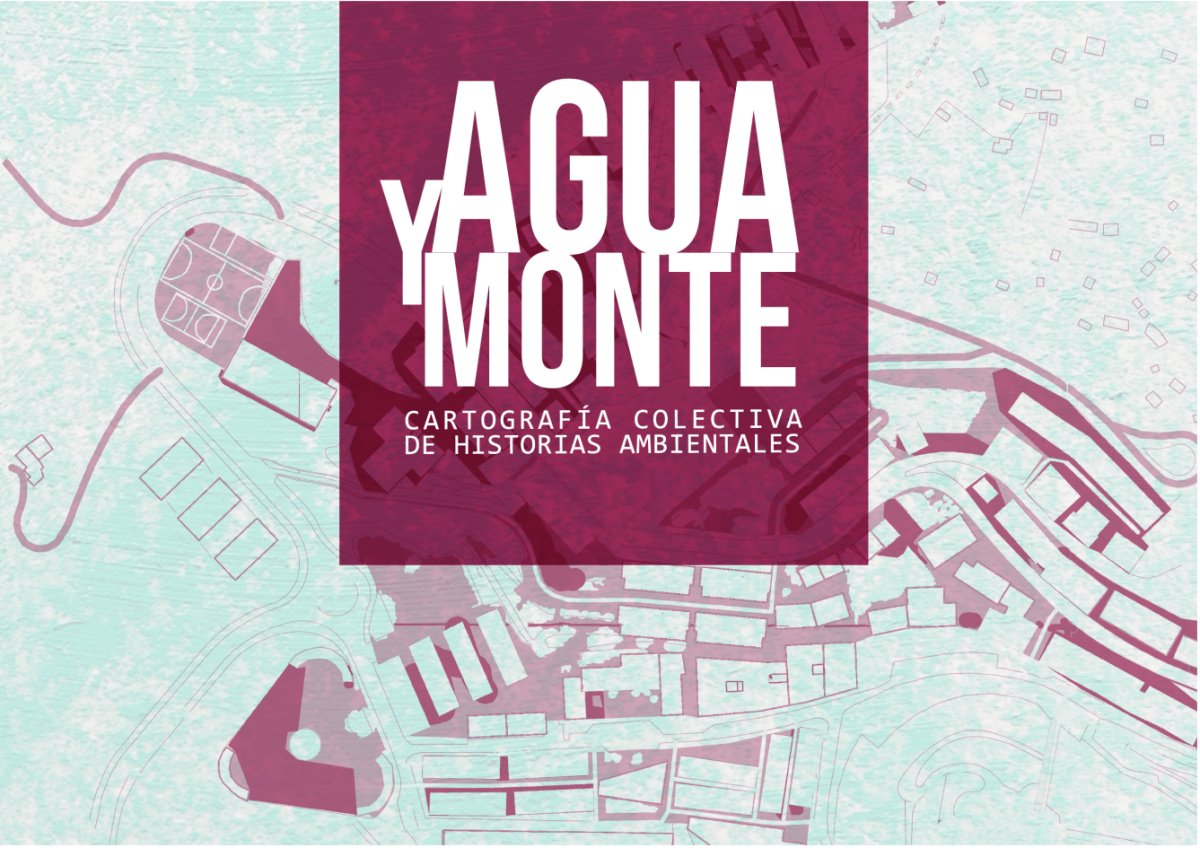
Agua y Monte

Cartografía colectiva de historias ambientales en los barrios de Uretamendi, Betolaza y Circunvalación (Bilbao)

Una de las tareas más urgentes ante el cambio climático es reimaginar las ciudades para que las personas y el resto de los seres vivos puedan adaptarse y tener una buena vida ante impactos como inundaciones, olas de calor y enfermedades. Para ello, una de las estrategias centrales hoy día es lo que se han llamado ‘Soluciones Basadas en la Naturaleza’, que buscan introducir procesos ecológicos en las transformaciones urbanas, por ejemplo añadiendo vegetación, volviendo a permeabilizar los suelos o creando espacios para que esos otros no humanos puedan vivir. Pero ¿Dónde quedan las personas en el despliegue de estas nuevas soluciones? 

En el proyecto ‘Integrate NbS’ financiado por el Ministerio de Ciencia e Innovación y el partenariado europeo “Dirigiendo las transiciones urbanas” hemos explorado esta pregunta desde un enfoque integrador, abordando problemas socioambientales concretos desde una perspectiva de adaptación al cambio climático y equidad social. El objetivo del proyecto es desarrollar una metodología de participación social mediante Laboratorios Integrativos, involucrando a diferentes actores clave, la ciudadanía, asociaciones locales, instituciones públicas y científicas.

En Bilbao, se focaliza en Betolaza, Circunvalación y Uretamendi. Barrios asistidos por la oficina OpenGela para facilitar la regeneración urbana fomentada por el Ayuntamiento y Gobierno Vasco. Los tres barrios tienen una historia común, sus habitantes originales son mayoritariamente migrantes de zonas rurales españolas, establecidos en Bilbao en 1950 en lo que por entonces era un monte, las faldas del Arraiz, con algunos arroyos atravesándole. De ahí el nombre de Ur-eta-Mendi, Agua y Monte en Euskera.

Gracias a su organización colectiva construyeron viviendas, infraestructura, obtuvieron transporte público, resistieron relocalizaciones y mantienen su sistema de huertos. Actualmente, conviven allí los habitantes originales, sus descendientes y migrantes internacionales. Las asociaciones locales destacan la necesidad de promover la cohesión social y la convivencia. La zona está rodeada de áreas naturales y de recreación del municipio. 

A través de entrevistas y laboratorios colaborativos, desde Integrate NbS investigamos cómo han evolucionado los vínculos entre las personas y su entorno natural, y cómo estos pueden fortalecer la cohesión social. El proyecto busca también sensibilizar a las instituciones públicas, especialmente al Ayuntamiento, sobre cómo diseñar SbN que sean inclusivas, equitativas y adecuadas al contexto local.

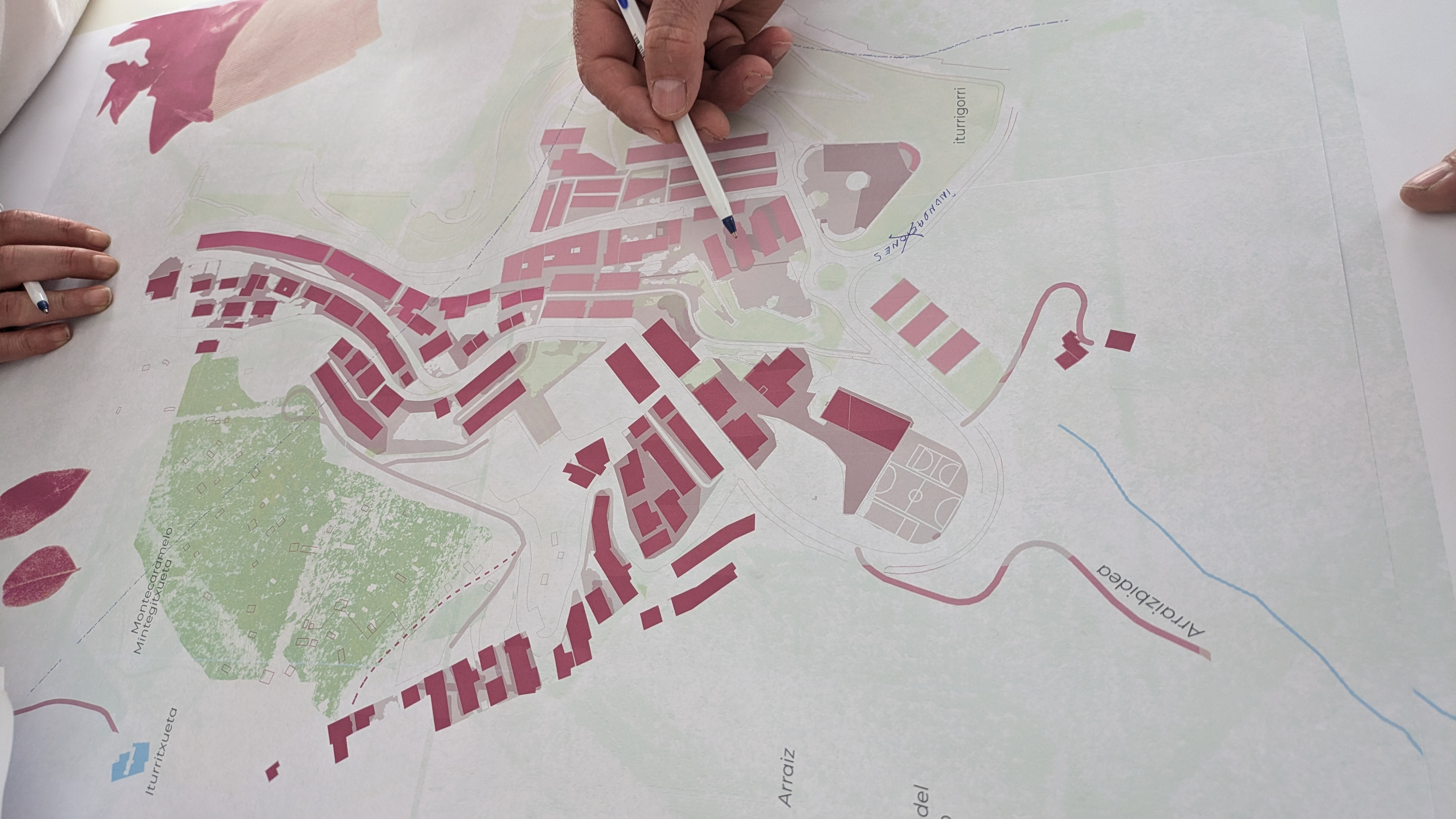
Uno de los resultados de este proyecto fue la creación de una cartografía colaborativa de historias ambientales en conjunto con las vecinas. La cartografía fue diseñada por Julia Alvarez Tola, quien acompañó su desarrollo para lograr a través de un mapa y un libro expresar las diferentes experiencias vividas por las vecinas a través del espacio y el tiempo. Esta cartografía reúne 7 historias en 7 capas que narran la organización social, el sentido de comunidad, cambios socio-históricos en la misma y en  la forma de relacionarse con el entorno a medida que los barrios se fueron construyendo. También relatan los modos de organizarse colectivamente ante situaciones ambientales adversas como incendios e inundaciones, las vivencias y juegos en el monte desde la infancia, el recorrido de ríos hoy día soterrados o la conformación de huertas. 

La información recopilada en la cartografía pone en relevancia 4 puntos: 

1- La contribución de las capacidades de organización colectiva para hacer frente a cambios ambientales extremos. 

2- La importancia de la participación vecinal para la creación de conocimientos robustos que den sentido al despliegue de procesos de regeneración urbana inclusivos.

3- El registro de las experiencias prácticas cotidianas de relación con la naturaleza, como el cuidado de jardines o las salidas al monte, para apoyar el diseño de nuevas soluciones basadas en la naturaleza que sean sostenibles en el tiempo.

 4- La construcción de memoria colectiva sobre los cambios socioambientales en el pasado y cómo esta puede ayudar a pensar nuevas estrategias tanto de cohesión social como de colaboración entre diferentes actores en los procesos de regeneración urbana. 

La cartografía y sus historias han servido para visibilizar una parte de la historia de estos barrios que estaba menos presentes en los relatos de las personas que lo habitan, también para repensar el presente desde esos aprendizajes y diseñar SbN que emerjan desde ahí. Ojalá vuele lejos e inspire otros procesos en los tantos barrios urbanos que están inmersos en eso de transitar.

Descargar:

Cartografía e Historias en Español

Kartografia eta Historiak Euskeraz

Categories
co-production Mar Menor research socionatures

Speculative natures: this changes everything

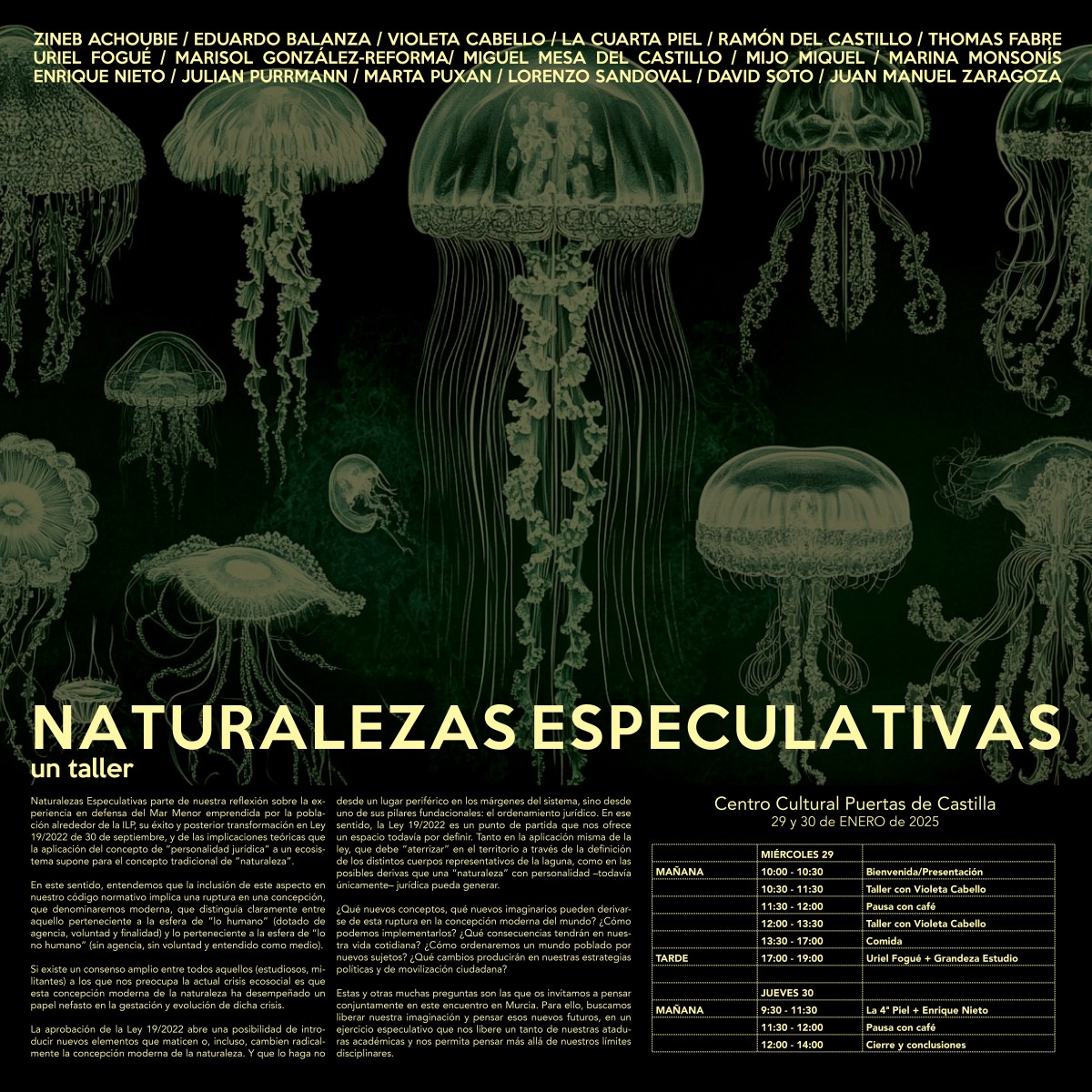
Program of the workshop Speculative Natures, organised by the ehColab in Murcia, January 2025. Author: Miguel Mesa del Castillo.

My colleagues from the ehColab in Murcia, Juanma Zaragoza and Miguel Mesa, invited me to participate the workshop ‘Speculative Natures’, organised in the frame of the Ant-Mentalhealth project, and facilitate a participatory activity. When I asked what they expected from the session, their framing was: we want to explore what it means to consider natures as people, as subjects with rights, what does it change? We are triggered by the experience of the Mar Menor being granted the legal personhood status, but we dont want to bound the session to this place.

The first thing that came to my mind was the session ‘Systems sensing in organizational complexity’ in the Transformations conference 2023 in Prague I had the pleasure to join. It was facilitated by Justus Wachs & Luea Ritter and focused on what they call systems sensing: ‘a visceral aptitude that draws on innate human capacities for being in relation with, listening deeply to, and momentarily embodying the elements of a system’. This quote is extracted from a paper they published in the Social Innovations Journal systematizing their experience, which I was immensely happy to find and get inspiration from. This post is meant to be a record of how I adapted their methodology for anyone interested in using it in the future.

A second source of inspiration was brought by Juanma, who is a huge expert in Bruno Latour. It’s the methodology developed by the consortium Où atterrir ? to explore new ways of describing territories as holobionts, by describing dependencies composing locals with distant peoples and activities, who might be threatened by those dependencies without us knowing.

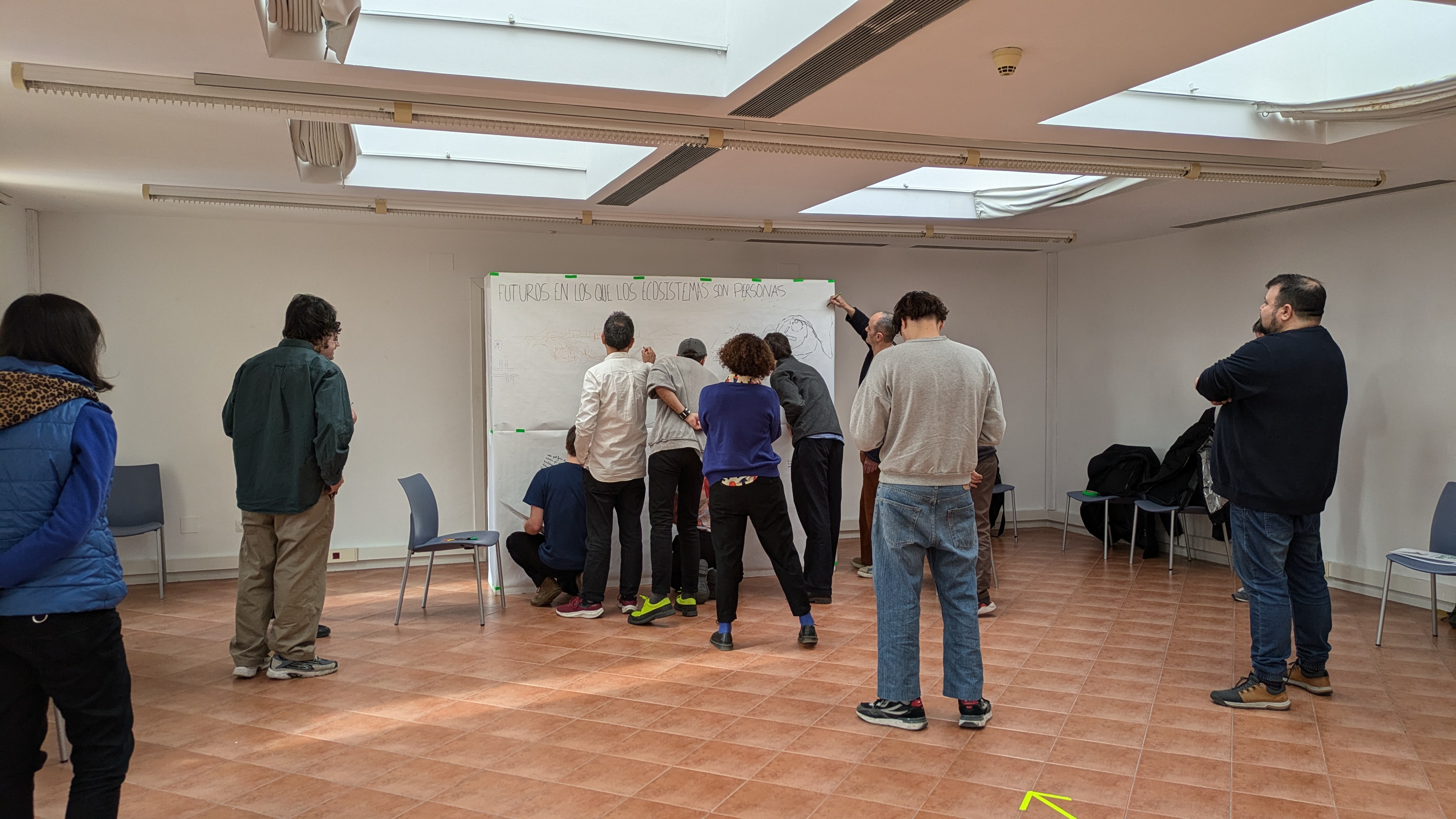
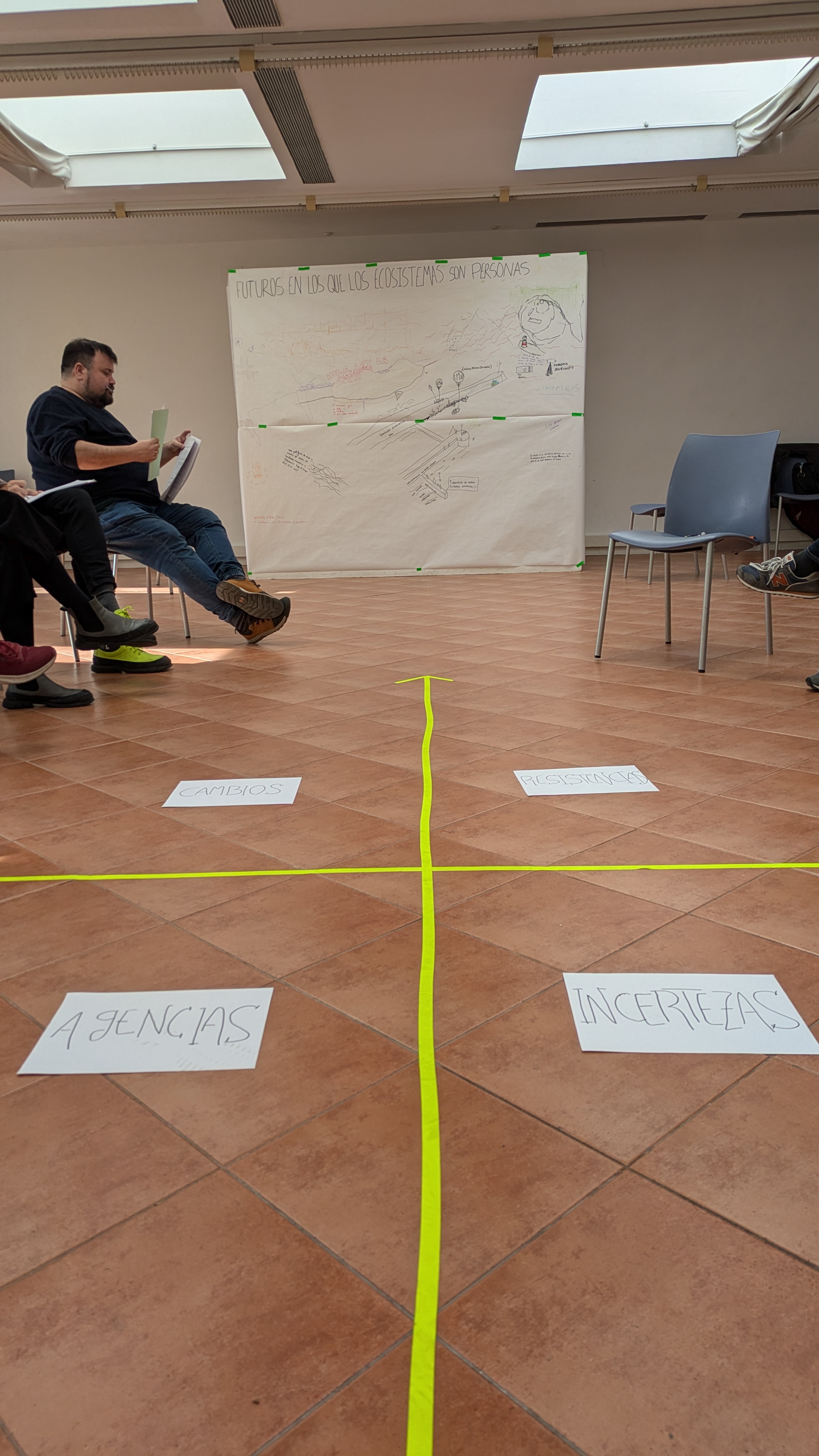
Connecting these two methods, I planned a session in two parts, moving from an embodied experience towards a structured dialogue. The first part was meant to explore the question: futures in which ecosystems are people, how do they look like? Following Justus and Luea, we started with some exercises from Theory of the Oppressed to tune up our bodies and sensory capacities. Moving throughout the room, participants were invited to shift a few times back and forth from their inner attention towards the group and the room. Then they played with different walking paces and with stopping to talk with one person while keeping their attention to the group.

After warming up, we entered a guided visualization inspired in constellations as described by Justus and Luea in their paper. Participants chose a place in the room from which they jumped to another spot to visualize a concrete territory in which ecosystems are people. The exercise was repeated several times, following these questions:

  • Observe: How is this territory? Where does it end? What’s in there, what beings, entities or things? How are their relations, their dependencies?
  • Feel: How are you related to this territory? Are you close or far away? Are you an observer or a participant? What does this territory mean to you?
  • Speculate: What resources and material, affective, political agencies do ecosystems-persons have in this territory? maybe there are people willing to take care of them, or institutions that protect them…
  • Analyze: What are the resistances to ecosystems being considered and cared for as people? maybe there are groups feeling marginalized, lobbies exerting pressure, legacies of the past…
  • Jump: make a movement that symbolizes for you the lever that allows this territory to exist. When you arrive, explore for a few minutes how is the path to arrive to this territory…

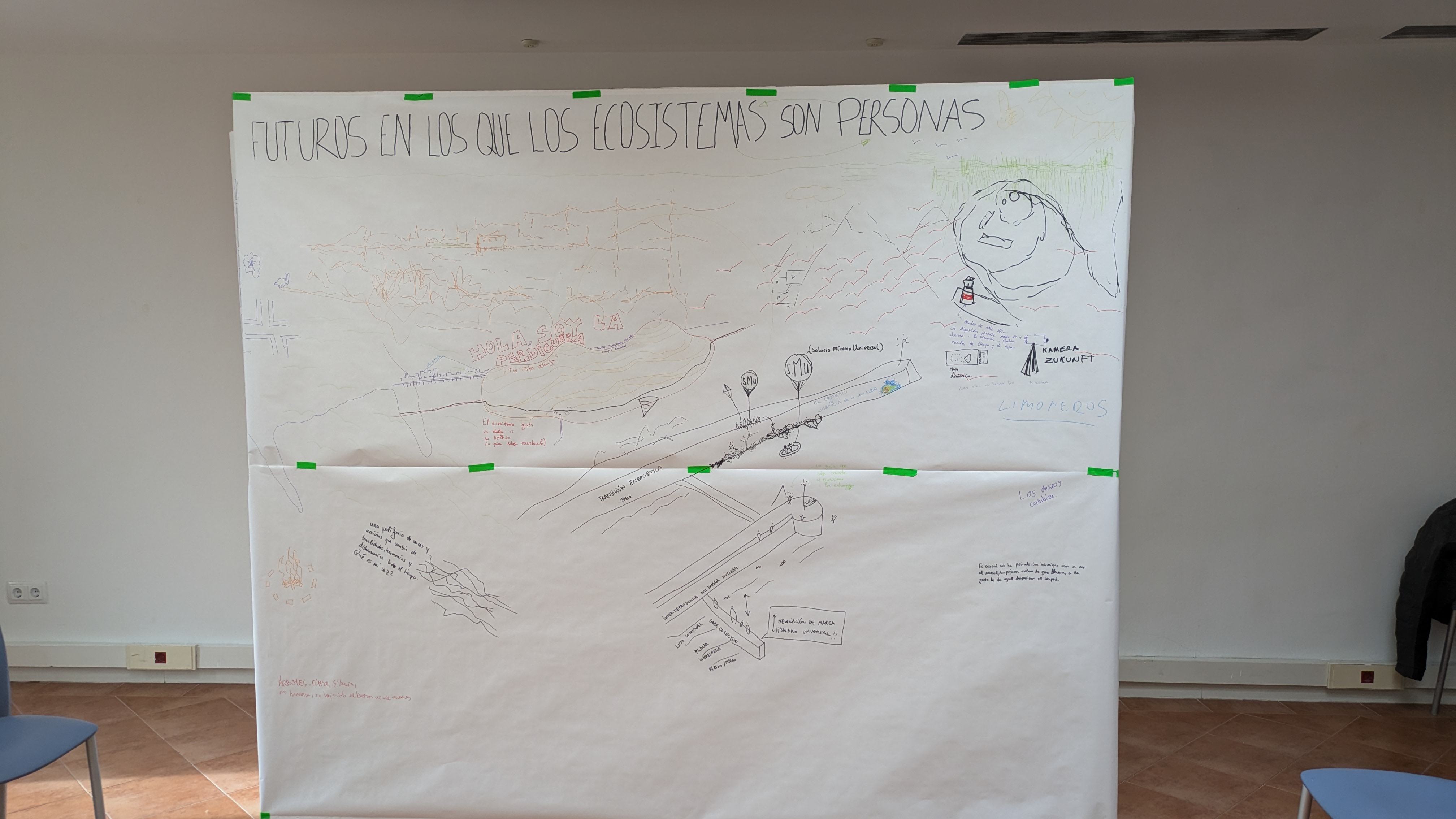
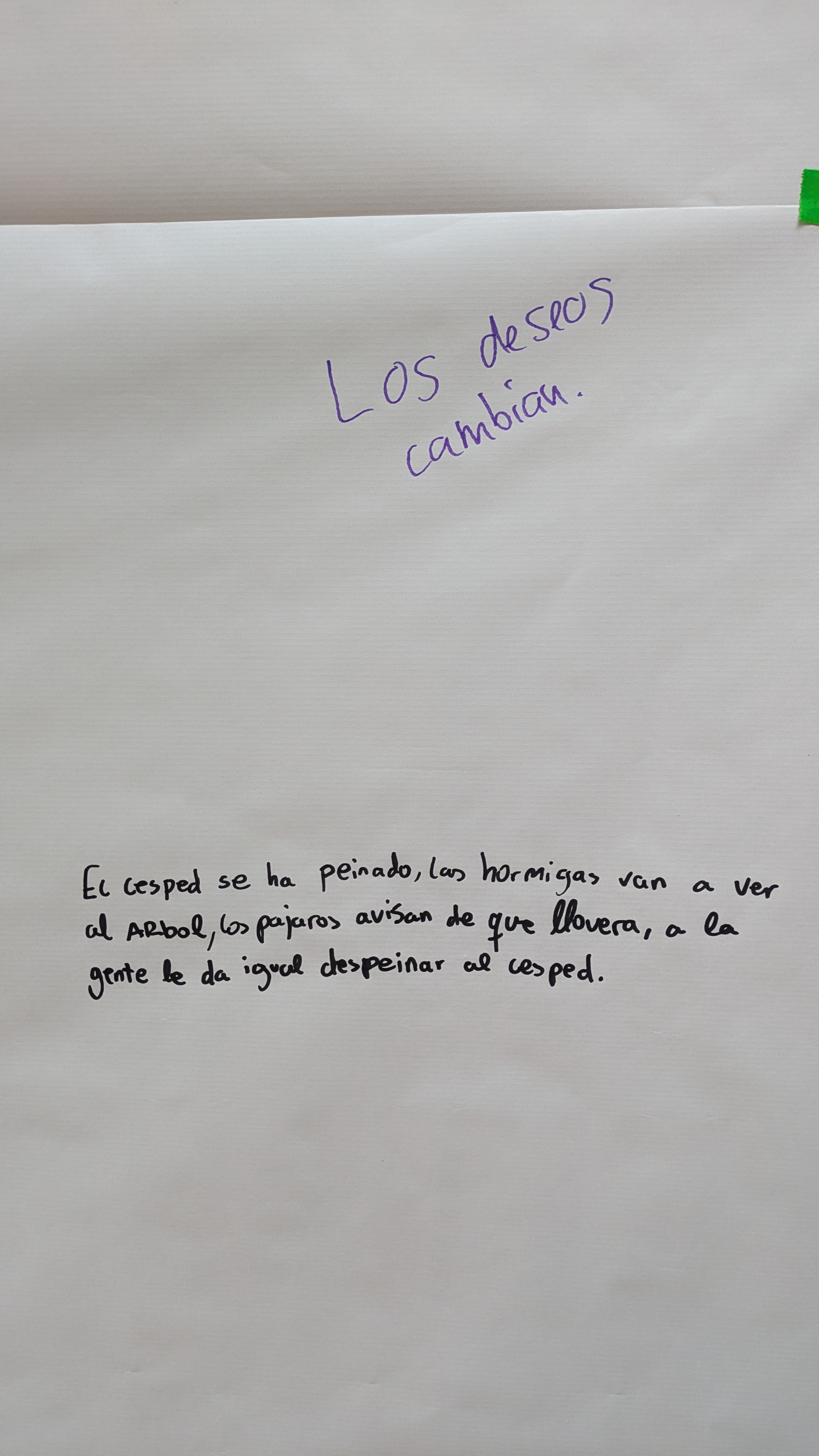
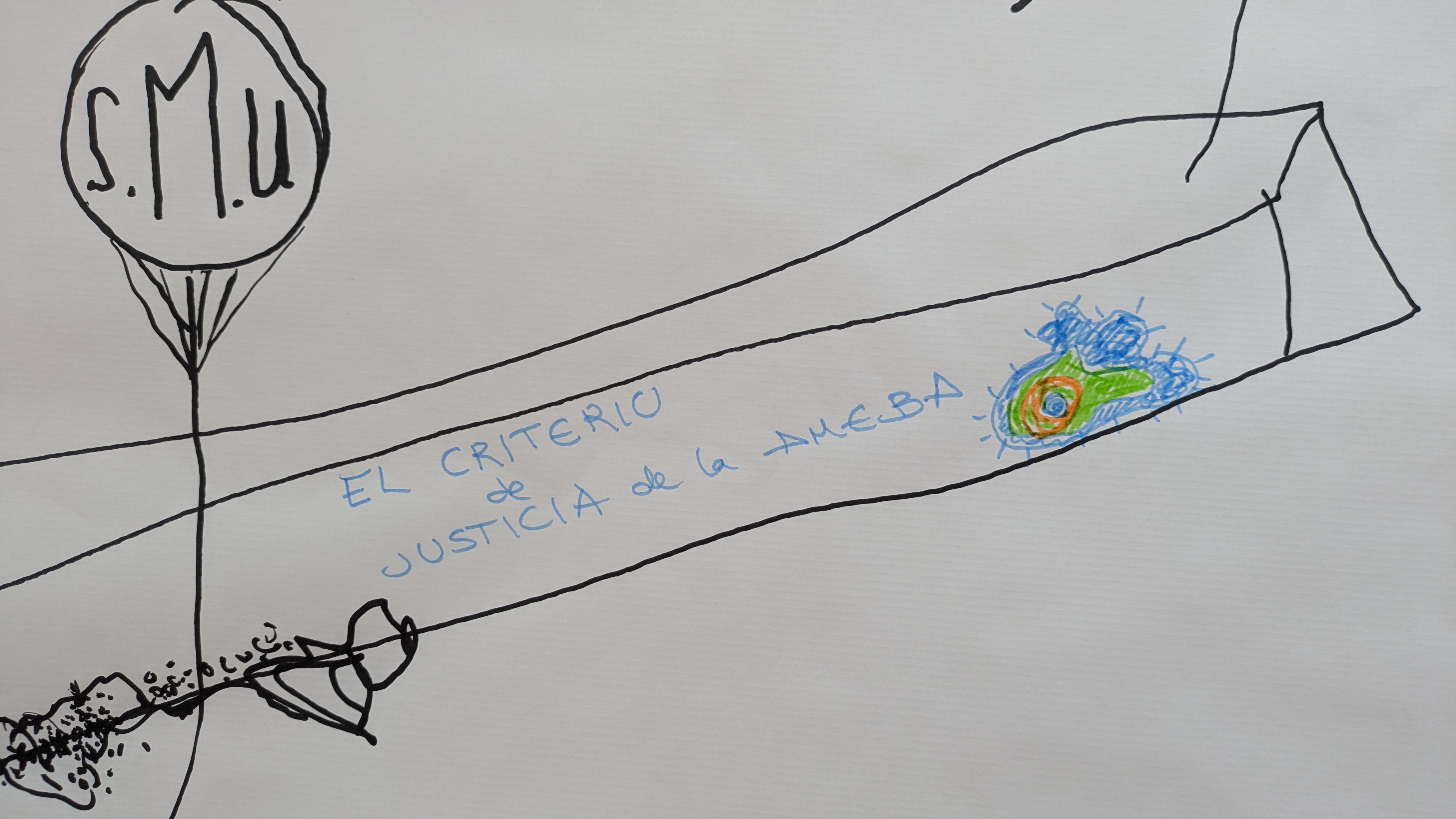
The journey was done individually and in silence. Participants could move and make noises, but the idea was avoiding talk to give space to other types of information. After the last jump, they were invited to draw together in a wall paper, still in silence, whatever they liked to capture their experience.

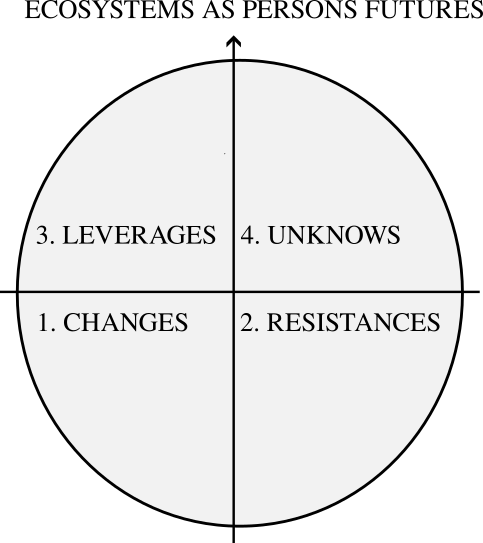
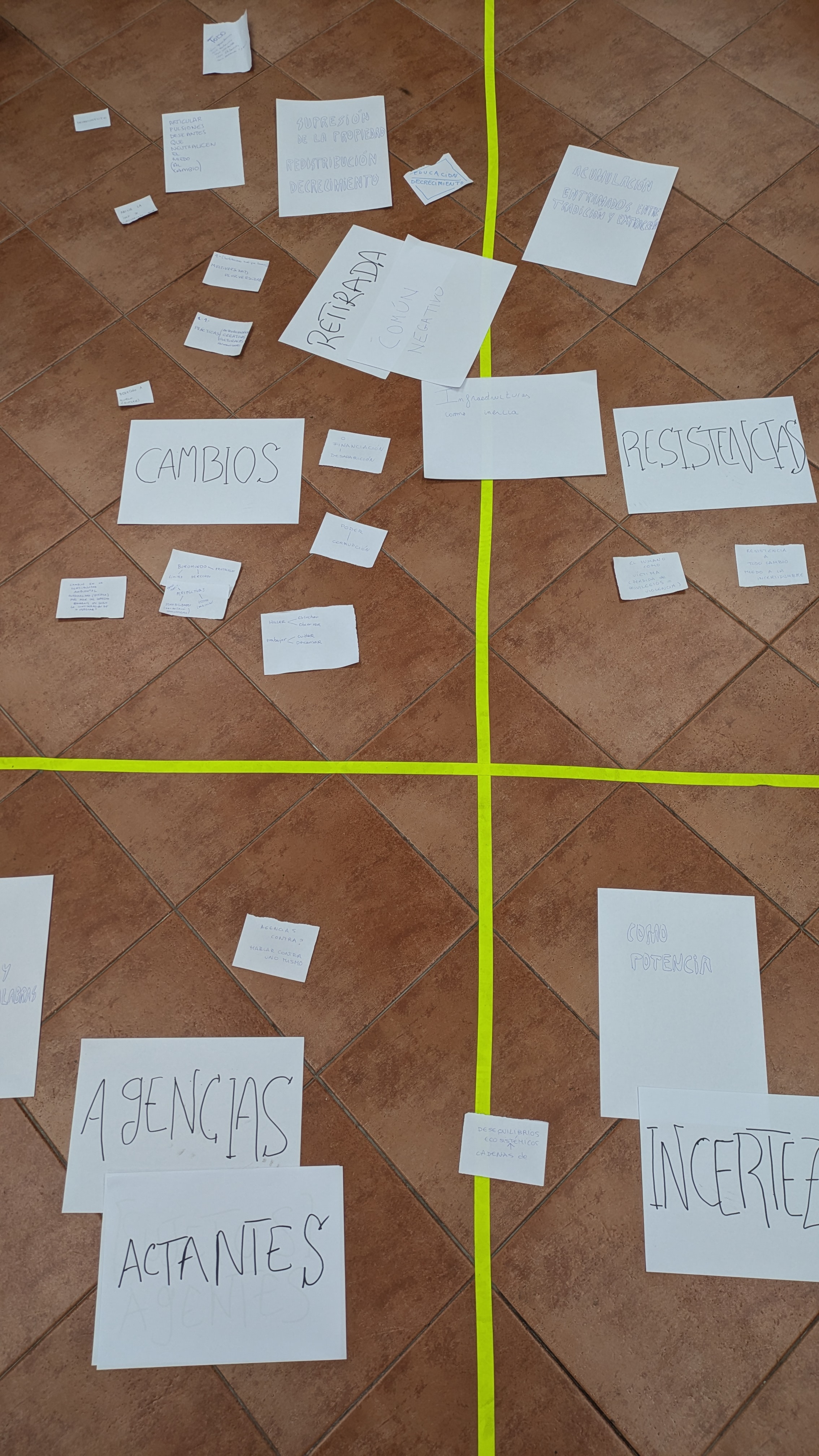
The second part opened a collective conversation about: What changes do futures in which ecosystems are people bring forth and how do we drive them forward? Here we drew on the four-quadrant method of Où atterrir ?, rephrasing categories in:

  1. Philosophical, political, scientific, artistic transformations
  2. Resistances, barriers and push backs
  3. Resources, agencies and actions that can be activated as levers
  4. Uncertainties, known unknowns, questions that arise

We spent some time discussing and reframing the categories before entering the conversation. I did not audio record and cant really summarize the discussion 2 months later. I recall the 1 hour time felt quite short, as there’s much to discuss on this new matter of concern. I also remember one of the final sentences from Juanma, that really gives me hope: to me, this changes everything.

Categories
Mar Menor publications socionatures

Pensando con el Mar Menor: ¿Sujeto revolucionario?

En este post comparto algunas ideas que desarrollamos con mi amigo Eduardo Serrano, arquitecto, urbanista, pensador crítico y atípico, activista de la Casa Invisible, y una larga cola de adjetivos admirativos, en unas charlas Bilbao-Málaga durante 2023. Nos invitaron a escribir algo para el seminario ‘Paisajes de abandono’, organizado por Gabriel Gatti e Iñaki Rubio del grupo Kontu Laborategia, que ha acabado en un capítulo (download preprint) del recién publicado libro ‘Contar el abandono. Paisajes de un mundo en ruinas‘.

La invitación fue a relacionarnos con la idea de abandono, que Gabriel Gatti ha desarrollado ampliamente a partir de su trabajo sobre desaparecidos, enfocando el Mar Menor como paisaje de abandono. Y entramos a navegar con esa brújula pero pronto se nos desnortó y nos fuimos por otros derroteros. Porque ¿Cómo puede comprenderse que el mayor conflicto ambiental del estado español de los últimos años, con los partidos mayoritarios confrontados, los científicos divididos y la sociedad fracturada haya conseguido declarar a la laguna y su cuenca sujeto de derechos? En el texto exploramos la contraposición entre una cartografía de abandono y otra de afectos, y creo que la clave para entender este territorio está en no evitar ni tratar de solucionar las profundas paradojas que hacen del Mar Menor lo que es. Cuanto más lo pienso más coincido con aquello que escribimos “el Mar Menor es una singularidad notable por la concentración de agudos problemas, pero también por las oportunidades que paradójicamente esos problemas abren“.

La nueva ley de personalidad jurídica del Mar Menor tiene un enorme reto por delante, crear la primera estructura de gobernanza participativa de un ecosistema como sujeto de derechos en Europa. Nadie sabe muy bien cómo va a resultar la que puede ser la mayor innovación política de lo que llevamos de siglo, está todo conformándose, los comités, las portavocías, las relaciones, los mecanismos. Escribíamos: “El trabajo con el Mar Menor y su comarca tampoco es recuperar una supuesta armonía ecológica ni un modo de vida pasado que ahora se nos antoja idílico. Es encontrar y activar potencias de las vidas que, ahora maltrechas y fragmentadas, habitan la laguna, muy probablemente generar un nuevo socio-ecosistema. En ese sentido el Mar Menor podría hacer valer su no humanidad como terreno neutral, pero radicalmente decisivo, por lo que todes nos jugamos, para una especie de pacto social entre las diversas gentes del territorio donde ostenta el principal protagonismo: ocasión para una nueva vida y para el aprendizaje de un nuevo modo de vivir, un vivir-con (Haraway, 2019)”

Esto nos llevó a especular con la idea de Gaia (a la Latour) como sujeto(s) revolucionario(s) más-que-humano(s), con el Mar Menor como instancia singular de estos nuevos sujetos, en al menos cuatro sentidos. Primero, y quizás más evidente, hay un “sentido político puesto que implica subvertir las relaciones sociales bajo la hegemonía del capitalismo como modo histórico de ser ecosocial”, que ha puesto a tantos territorios al servicio de la producción bajo una lógica de plantación tal como la discuten Ting y Haraway en este diálogo con Mitman. Pero, ojo, segundo, los procesos en Gaia tienen cierta autonomía respecto al juego político humano,“no podemos simplificar y asimilar la condición revolucionaria de Gaia a una especie de anticapitalismo”. El reconocimiento creciente de que las tormentas desatadas son difícilmente controlables, por ejemplo la eutrofización del Mar Menor que cuenta con altas dosis de incertidumbre, está desmoronando la idea moderna de dominio de la naturaleza. Tercero, hay también un sentido existencial, un cambio en las sensibilidades de la época que hace que el abandono del Mar Menor ya no sea una opción para la mayor parte de la población. Cambio derivado del reconocimiento de los vínculos que unen habitantes y laguna, “este vínculo nos interroga y nos demanda una autotransformación, un deseo de devenir otres para re-aterrizar en un lugar difícil de dibujar donde laguna y humanos puedan co-existir (Latour, 2017)“. Cuarto y último, los saberes también están cambiando y surgen nuevos aparatos teóricos y prácticos para una “agenda científica que «escucha» a Gaia“.

Sin duda una idea atrevida y que requiere de más exploración. Por ahora nuestro textito.

Categories
aqua co-production Mar Menor socionatures

Pensando con el Mar Menor: la pregunta y el problema

Han pasado tres años desde que mis pies tocaron por vez primera las cálidas aguas de la laguna salada en la costa murciana. También han pasado muchas cosas. Mi intención era usar este blog como herramienta para pensar-con el Mar Menor a medida que la investigación avanzaba. Por diversos motivos no he logrado hacerlo hasta ahora, cuando el trabajo de campo está concluido y ando elaborando los resultados en varios artículos en inglés. Así que quiero escribir una serie de posts en castellano que den cuenta del proceso, los dilemas y aprendizajes por el camino.

Cuando comencé en enero de 2021 escribí un esquema de investigación que contenía preguntas y objetivos, no muy articulado, lo justo para arrancar. Partí de una pregunta metodológica:

How to co-produce knowledge on wicked social-ecological issues characterized by severe ecological degradation, multi-actor conflict, social polarization and deep power asymmetries?

¿Cómo se puede co-producir conocimiento sobre problemas socioecológicos ‘wicked’, caracterizados por la degradación ambiental severa, el conflicto multiactor, la polarización social y fuertes asimetrías de poder? La pregunta ya me predisponía a explorar los CÓMO, los métodos, las tácticas, las prácticas, eso que había aprendido en mis dos años en Wikitoki y tanto les gusta a los amigos de Colaborabora. También en la formación en facilitación de IFACE cuyas herramientas quería trasladar a mi ámbito de investigación.

En concreto, lo que me interesaba era explorar la transformación de conflictos ambientales y su relación con eso que llamamos ‘conocimiento académico’ (en singular es obviamente engañoso). A un segundo nivel, estudiar la relación entre las experiencias afectivas del Mar Menor, el conocimiento del mismo y el conflicto social.

En ese momento partí de conceptualizar la eutrofización del Mar Menor como un ‘wicked problem’, siguiendo literatura reciente en el ámbito internacional en esta línea. El concepto de wicked problem fue propuesto Rittel y Webber (1973) para nombrar aquellos problemas que son difíciles de resolver. Venían de la ingeniería de sistemas donde las funciones de optimización son modus operandi. Se dieron cuenta que algunos problemas no respondían a su lógica optimizadora y, al ponerse a pensar sobre ellos, llegaron a definirlos a través de 10 características. Y con ellas, los construyeron en el imaginario investigador, expandiéndose pronto a distintos ámbitos de la planificación y las ciencias ambientales donde los problemas tienen múltiples dimensiones y escalas interconectadas y, por mucho que lo hayamos intentado, tampoco se resuelven con ecuaciones.

Sin embargo, mi lista de características descriptivas del problema social en torno al Mar menor iba bastante más allá de lo que Rittel y Webber plantearon. Y lo que encontré cuando me sumergí en el territorio fue mucho más. De hecho hoy pienso que es un concepto que se queda corto, aunque sirve para enmarcar una parte del problema. También se queda corto otro concepto que me ha influido mucho en mi vida académica y el de problema postnormal (Ravetz y Funtowick 1990), aunque sin duda las incertidumbres, los fuertes intereses en juego y la urgencia del problema son elementos importantes.

Hay elementos más profundos en el Mar Menor que apenas estoy empezando a nombrar y que tienen que ver con los vínculos con la laguna, el impacto afectivo de la eutrofización en la sociedad murciana, la falta de gobernanza o incluso el desgobierno, la tensión entre partidos políticos mayoritarios, la fragmentación social y territorial, y las desigualdades. En medio de esta madeja se encuentra el conocimiento académico, las controversias y las incertidumbres asociadas, instrumentalizadas por el conflicto, reforzando la polarización. Y otra capa de refuerzo: la campaña desinformación y negacionismo orquestrada por la extrema derecha, financiada por los que no quieren moverse ni un palmo de su lugar, que gana más y más adeptos en el Campo de Cartagena (como en el Egido y en Huelva, enclaves con ciertas resonancias).

Tratando de describir el contexto Mar Menor para el último artículo, me sumergí en la literatura de polarización. Se distingue entre polarización temática, ideológica y afectiva, y hay bastante debate sobre si están o no relacionadas. Debate que a mi me sorprende, porque me parece imposible que no lo estén, al menos en el Mar Menor. Me interesó mucho el concepto de cámaras de eco de C. Thi Nguyen, por su capacidad descriptiva de los mecanismos de refuerzo de la polarización: creación de confianza y narrativas compartidas intracámara, deslegitimación activa de narrativas extracámara. Más aún me interesó otro que dialoga con él, el de búnkeres epistémicos de Katherine Furman, porque señala la dimensión afectiva de estas cámaras: en ambientes hostiles, y hoy vivimos permanentemente en ellos, buscamos espacios en los que sentirnos seguras para compartir nuestros valores y opiniones abiertamente. El problema es que tienen fronteras y mecanismos que dificultan salir del bunker una vez que entras. Esto resuena también con la psicología social de los conflictos intratables que describen Halperin y Sharvit en un libro homenaje al legado de Daniel Bar-Tal. Si bien esta teoría se desarrolló a partir del análisis del conflicto Israel-Palestina, la idea básica es muy similar: hay un ‘ethos del conflicto’ que se autoperpetúa a través de la formación de creencias divergentes en torno a la legitimidad, la confianza y la unidad (nosotros vs vosotros) junto a orientaciones emocionales que las sostienen. Cuanto más concibamos al otro como del otro bando, más polarización y fragmentación, más reducción de la multiplicidad de posiciones y diferencias a dos únicas, confrontadas, identidades sociales.

Creo que algo de todo esto hay en el Mar Menor: hay dos bandos de actores sociales enfrentados, cada uno amparado en distintos niveles y partidos de gobierno, cada uno movilizando conocimiento experto para reforzar su narrativa y deslegitimar la de enfrente. Hay también fuertes asimetrías de poder, con algunos actores que ostentan mucho y se resisten al cambio, y otros que están en situación muy precaria y son prácticamente invisibles, especialmente los trabajadores migrantes. Hay duelo, tristeza, rabia y frustración por la situación de la laguna, y también victimismo y agravio, defensiva y negación. Y también hay mucha gente haciendo cosas, cuidando la laguna, cambiando sus prácticas, luchando por su reconocimiento como sujeto.

En 2022 concebí el Mar Menor como un laboratorio del Antropoceno/Capitaloceno/Chthuluceno, usando la triada propuesta por Haraway. Hoy casi que deseo que no sea laboratorio sino excepción, que no se multipliquen ni se expandan situaciones de tal complejidad porque traen mucho dolor y son (casi)imposibles de transformar hacia horizontes de más equidad y justicia social y ambiental. Al menos desde la mentalidad política predominante a la que le aterra la participación y la democracia.

A no ser que haya una revolución. Y quizás el Mar Menor la esté trayendo y no nos demos cuenta aún. Lo cuento en el próximo post.
Categories
co-production research socionatures

IntegrateNbS – Exploring the transformative potential of nature based solutions

Uretamendi, December 2023. Border between houses and gardens.

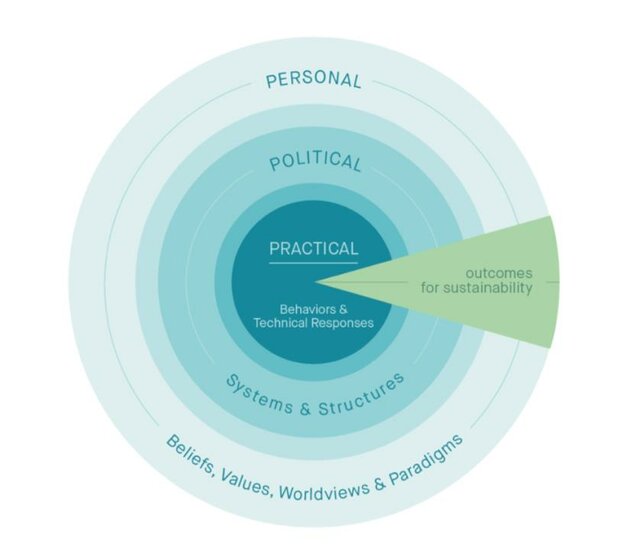
The IntegrateNbS project kicked off in January 2024. Funded by the Driving Urban Transitions partnership, the project aims to explore the ‘transformative potential’ of so-called nature based solutions (NbS) in urban planning. We work with the 3 Spheres for Transformation framework proposed by Karen O’Brian and Monica Sharma and count with the support of cChange as consulters expanding the application of this framework worldwide through their succesful Transformative Leadership for Sustainability program.

In a nutshell, the 3 Spheres framework considers that for sustainability transformations to be effective, they need to happen at three interconnected levels: the practical interventions in the world, at institutional systems and structures and in peoples values, beliefs systems and worldviews. From this lens, a practical intervention like a NbS could be more transformative if changes are induced in the institutions and policies planning for it and in the values of people affecting and affected by it.

IntegrateNbS aims to contribute to an identified knowledge gap concerning the consideration of social dimensions, such as equity and justice, in the design and implementation of NbS. Its main output will be a co-creative methodology, the ‘IntegrativeLabs’, to include such dimensions when developing NbS. We have 6 case studies in 4 European countries (Norway, Sweden, Poland and Spain) in which we will test this methodology to accompany existing NbS planning processes.

What I really like from this process is having cChange as internal coachers helping as build a solid foundation for an interdisciplinar and intercultural collaboration. We have internally applied the 3 Spheres framework to organise ourselves as a team. We will also apply it as the baseline for designing the Integrative Labs. I dont often work from pre-defined frameworks but I see value in this heuristics that is sufficiently simple to give room to diversity, while sufficiently complex to enable collective comprehensive thinking.

The Spanish team at the Basque Center for Climate Change is working with two case studies. First, in a pheripheral neighbourhood in Bilbao, Uretamendi, self-constructed by migrants that came from other parts of Spain to work in the industries during the 50-60s. It is literally a village carve up in the mountain, an ecotone between the urban and the forest (see pic at the beginning of the post). Our research in Uretamendi will focus on understading how people relate to nature in the area and how this can inform local council plans for renaturalization.

Second, we are working with the EbroResilience Strategy, a large scale policy initiative involving 5 public administrations to transform flood risk governance in the middle Ebro river. EbroResilience has been implementing NbS for the last 5 years as a new way of co-habiting with the river rather than attempting to control it. Yet, this shift to NbS has triggered strong confrontation and conflicts that are being attended through an ambitious participatory and conflict transformation program. The work with EbroResilience will be a collaboration to developing an evaluation framework and assess the transformative potential of their participatory strategy, a framework that will be later applied to the other case studies.

Categories
co-production Mar Menor reflections research socionatures

Ecotono: compartiendo diálogos sobre el Mar Menor

Todo lo que empieza acaba y a mi investigación en el Mar Menor le va tocando cerrar. Después de dos años y medio de intenso trabajo de campo, ahora llega un tiempo de reposo, lectura, digestión, análisis y escritura.

Eso sí, hemos hecho un esfuerzo por compartir el proceso y los primeros resultados. Con mucha alegría publicamos la web del proyecto Diálogos Compartidos / Shared Dialogues, que culmina la investigación participativa y la expande con una exploración de herramientas visuales para contar algunas de las reflexiones que hemos recogido o provocado en nuestros encuentros.

Además, escribimos dos breves textos que recogen las conclusiones principales de la investigación respecto al problema del Mar Menor y respecto a cómo fomentar la participación social.

Por último, la guinda del pastel, una preciosa publicación que recoge las historias que hemos elaborado junto a la artista visual Josune Urrutia y mis compis de investigación Paula Novo, María Mancilla, Marcela Brugnach y Paula Zuluaga. Después de darle muchas vueltas la llamamos Ecotono pues al ordenar las historias buscamos esas zonas intersticiales en las que friccionan las dicotomías respecto a lo que se dice, se siente y se hace en el Mar Menor. Esperamos que os guste.

Imagen del cangrejo azul. Josune Urrutia.

Categories
aqua Mar Menor publications research socionatures

Why uncertainty matters in environmental degradation? The Mar Menor case (VI)

Our latest paper analyzes the narratives and uncertainty surrounding the dispute over the overfertilization of the Mar Menor lagoon in Spain. Harmful algal blooms, dead zones, and fish kills are the results of eutrophication – a process that occurs when the environment becomes enriched with nutrients, mostly nitrogen and phosphorous, increasing the amount of plant and algae growth to estuaries and coastal waters.

The Mar Menor lagoon is a protected aquatic area in Southeastern Spain that has been receiving nutrients from poor sewage systems and fertilizers over the last five decades. Early in the 2000s, scientists started warning that the lagoon could become eutrophicized. In 2016, its waters turned green when algal blooms killed off 85% of the vegetation on its seabed. Later in 2019, an event of anoxia – depletion of oxigen in the water – produced tons of death aquatic biota.

In this study, we explored the narratives that explain the causes and potential solutions to the lagoon’s crisis. Results show two increasingly polarized narratives that deviate in the causes for nutrient enrichment and the type of solutions seen as effective: (1) intensive agriculture is the main driver for the Mar Menor eutrophication; and (2) the lagoon has many and complex pressures, agriculture is only one of them.

We further analysed the role of uncertainty in this polarization dynamics. Findings revealed how different uncertainties are mobilized to dispute the centrality of agriculture, like the lack of data on water and fertilizer use or a scientific controversy over the contribution of groundwater to nutrient discharges to the lagoon.

This research contributes to understand eutrophication as an intertwined social-ecological phenomena and how knowledge generation can contribute to sharp polarization. We conclude that different inter- and transdisciplinary approaches may be needed to collectively unpack existing uncertainties.

Cabello, V., Brugnach, M. Whose waters, whose nutrients? Knowledge, uncertainty, and controversy over eutrophication in the Mar Menor. Ambio 52, 1112–1124 (2023). https://doi.org/10.1007/s13280-023-01846-z

Categories
co-production epistemology publications reflections socionatures

Quantitative Storytelling: Science, Narratives, and Uncertainty in Nexus Innovations

Our collective reflection after four year research in the @MAGIC_NEXUS project has finally been published (open preprint: https://zenodo.org/record/5670658#.YYz5bruCFH4). This was a slow and careful science process. We took the time to think together, to cross-analyse our different experiences with the Quantitative Storytelling approach (QST) and to let new insights and learning emerge. I wish I had more of this in my hectic academic life.

We started by looking back at the onset of the MAGIC project, when QST was conceived as an iterative research process that linerly combined narrative analysis, multi-scale assessment of the water-energy-food nexus and stakeholder engagement, with the purpose of transforming dominant policy narratives around innovations for sustainability. We then created a framework for comparing the four innovation cases were involved in: biofuels, shale gas, electric vehicles and alternative water resources. We realised that our processes had not been as linear and iterative as expected. We arrived at a different view of the QST process in which two main avenues can be considered: 1) challenge dominant narratives on innovations as solutions for sustainability problems; 2) co-create new narratives and imaginaries. Rather than direct policy or narrative change, the outcomes from these processes might be diverse and diffuse. They extend beyond the observed time frame and are harder to trace or quantify.

In the long run, routes of this kind may contribute to shared alternative socio-technical imaginaries that may, in turn, lead to changes in the governance of nexus innovations.

Categories
aqua Mar Menor socionatures talks

Slides from the conference on sociohydrology

Last september I attended the very exciting Delft International Cnference on Socio-hydrology. I was surprised by the interest in interdisciplinary water studies, the deepness of discussions in this direction, and the incredible online-offline setting.

My talk was entitled ‘Eutrophication as an opportunity for multispecies water justice’. I drawed on the work of Alix Levain et al. (2020) that conceptualizes eutrophication as a hydrosocial problem to share some ideas and preliminary results from the Mar Menor case.

Here my slides.