Understanding Our Affective Connections to the Mar Menor
I am thrilled to share my latest preprint, “Socialecological affective arrangements: diving with a small sea of many seas,” available also on the PhilSci-Archive, and under review in Nature Social Sciences and Humanities Communications.
This work represents a deeply personal and academic journey into the heart of the Mar Menor in Southeastern Spain. As many of you know, this saltwater lagoon has faced devastating ecological crises, from microalgae turning the water green in 2015 to mass fish die-offs in 2019 and 2021 due to eutrophication. As I analysed in depth in a previous work, eutrophic crises triggered an important sociopolitical conflict in the region, gradually leading to deep seated divisions between coastal and agricultural communities. Yet, amidst this degradation, the Mar Menor has also become a global milestone as the first ecosystem in Europe to be granted legal personhood.
Why “Affective Arrangements”?
In sustainability science, we often reduce environmental problems to scientific facts and reports. While crucial, these “facts” often overlook how we actually feel and experience our ecosystems, how we develop our identities in relation to them.
In this paper, my co-authors and I explore the concept of Social-Ecological Affective Arrangements (SEAA). We draw on the work of philosopher Jan Slaby & colleagues, in particular their notion of affective arrangements. With them, we argue that emotions like grief, rage, or hope are not just internal feelings; they are ways of relating people, things, spaces, and practices that mutually affect one another. We also take their distinction between affects and emotions as valuable for socialecological relational analysis, considering socialecological processes as affective.
The Mapparatus: Visualizing the Invisible
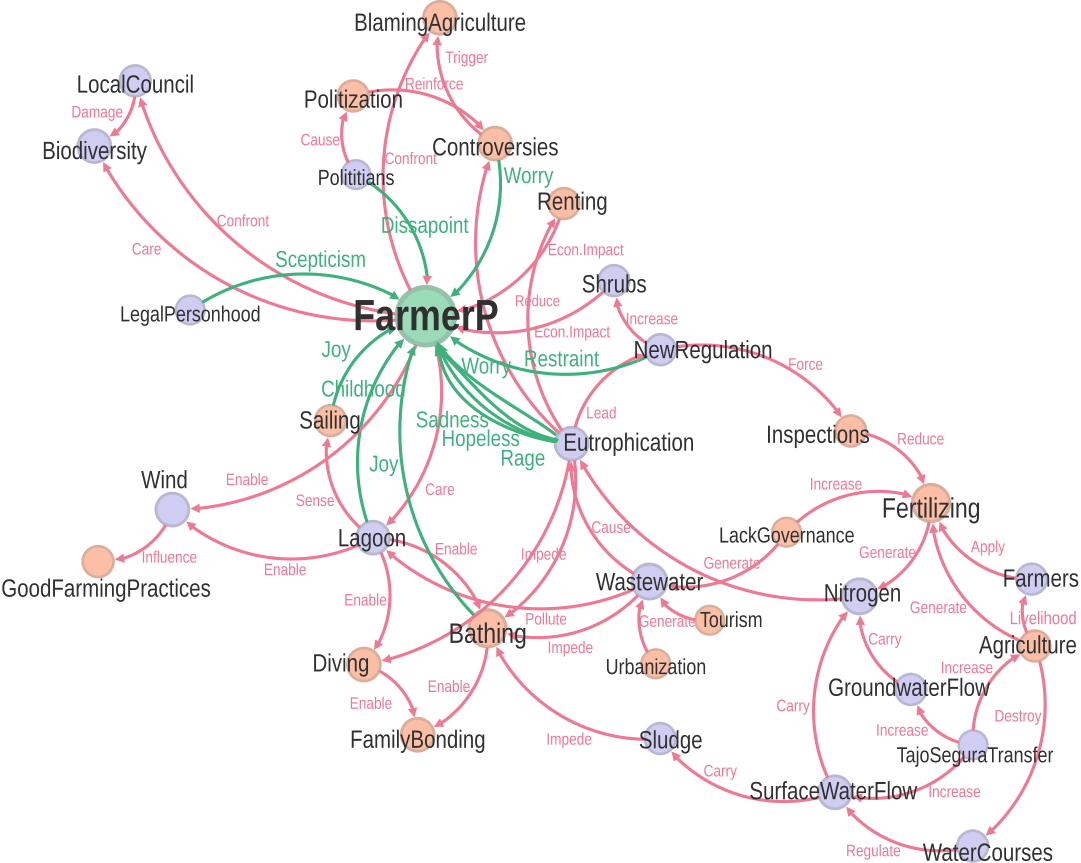
To bring this theory to life, we developed a methodology we call a “mapparatus”. By conducting relational interviews with local actors in the Mar Menor—including farmers, fishers, and biologists—we extracted the affective structures of their lived experiences and coded them into a network dataset.
We used network analysis to visualize these “SEAAs,” showing how, for instance, childhood memories of swimming are inextricably entangled with nitrogen molecules and agricultural runoff in the eutrophicated Mar Menor; or how the lagoon’s green waters directly modulate the mood and agency of those living on its shores; or how facts and emotions align: Participants with similar emotional attachments to the territory often share similar views on why the crisis is happening.
Beyond Polarization
Our results reveal the Mar Menor not as a single body of water, but as a “sea of many seas”. While there is division between agricultural and environmental narratives, our mapparatus also highlights “bridging” individuals who hold the potential for transformative learning.
I believe that by “emotionalizing” socialecological analysis, we can better understand why different people narrate different worlds in the same environmental crisis. Only by acknowledging these affective entanglements can we hope to move toward an agonistic and inclusive governance for the Mar Menor.
I invite you to read the full preprint and dive into these affective waters with us.
Read the full paper here: Socialecological affective arrangements: diving with a small sea of many seas
How do you “think-feel” your local environment? I’d love to hear your thoughts in the comments.

