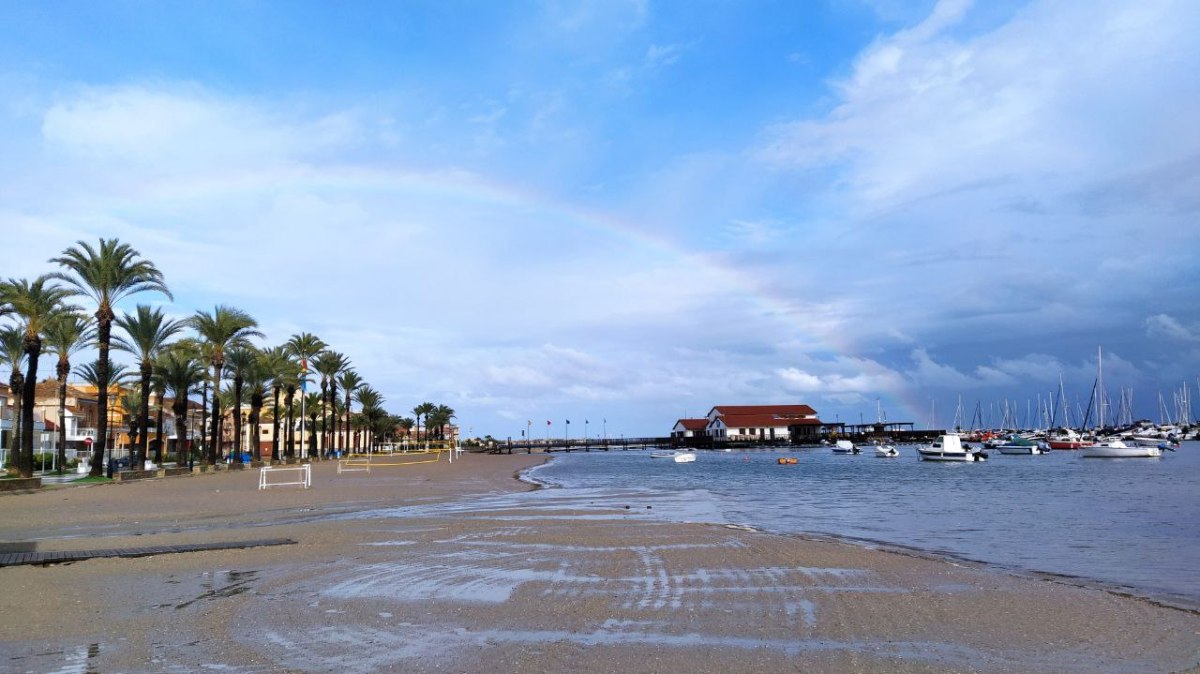
This might be the first paper I’ve ever truly written. I’m really proud of the knowledge co-production process co-led with Paula Zuluaga Guerra to explore the dispute over eutrophication of the Mar Menor lagoon in Murcia, Spain. I’m also happy with the theoretical framework and the analysis I present in this, my first sole author, article. The paper is published in Ecology&Society (open access!), as part of a Special Feature on knowledge co-production within environmental conflicts in which at least 10 more papers will be published in the upcoming months.
In the paper I argue that societal polarization, understood as a political and relational process of division that extends to multiple spheres of social coexistence, is becoming a hindrance to environmental governance and sustainability transformations. To substantiate my argument, I describe the process of polarization over the Mar Menor eutrophication as a gradual entanglement of epistemic, political and affective differences into two divergent social identities, ‘saviours of the lagoon’ and ‘denialist of the lagoon’, who confront the responsability of agricultural activities in the lagoon’s crisis.
I then focus on the question of how knowledge co-production can open transformative avenues within highly polarized environments such as the Mar Menor. For this purpose, I suggest that co-production focusses on relational transformation rather than on generating particular knowledge outputs. Drawing on relational-processual and affect theorists, I suggest that relational transformation requires placing attention on how differences emerge from and are transformed within affective relations in knowledge encounters. This stance on co-production assumes that i) knowing is a relational process of meaning making, ii) that emotions and affects are the relational substance out of which new collective meanings emerge and iii) a dissensus perspective for ‘together doing difference’, using Helen Verran‘s expression.
Our knowledge co-production process in the Mar Menor was inspired by a feminist ethos of care and by the Transformation Labs approach, specially the one organised by a great team of transdisciplinary scholars in the Xochimilco wetland in Mexico city. For our process, we combined insights from this experience with other participation and conflict transformation tools in an open ended process of collective inquiry in five phases, each phase having an expected relational outcome. To analyse relational transformation along the process, I take inspiration on the concept of diffraction as proposed by Donna Haraway and Kared Barad.

The diffractive analysis helped me understand how the polarizing pattern was expressed within the group of participants as cycles of framing, blaming and eluding rensponsibility, a responsibility trap. How then to move from responsibilty as a trap to response-ability as a relational quality, as suggested by Donna Haraway? I identify those moments in which the trap was challenged or shifted to a different co-response-able pattern by recognizing the lagoon as a shared matter of care, foregrounding how knowledge affects, embodying polarized narratives, exposing uncertainties in contested facts, and demonstrating that action can be taken even under uncertain conditions.
This work highlights the potential of relational-processual approaches in addressing complex environmental challenges. By focusing on differences, affects and co-response-ability, we can create partial aggreements and pathways for weak yet possible collaboration within dissensus. I hope this study contributes to ongoing discussions about finding ways to advance sustainability transformations amidst discord.
Here a graphical summary of the process and learnings:

 Violeta Cabello