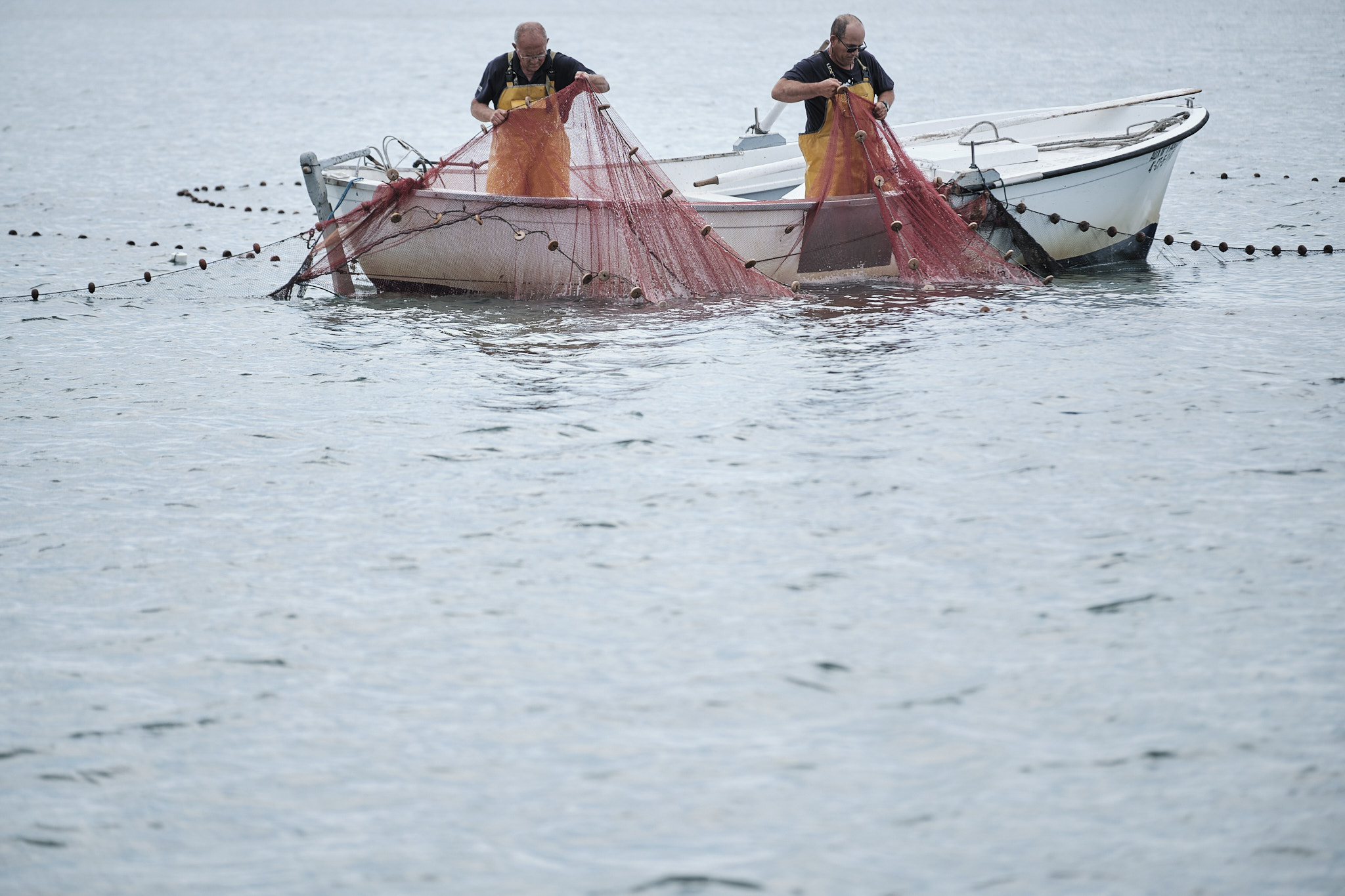
A collaborative project born from previous research in the Mar Menor [see my Ramón y Cajal research on the Mar Menor page].
What this project is
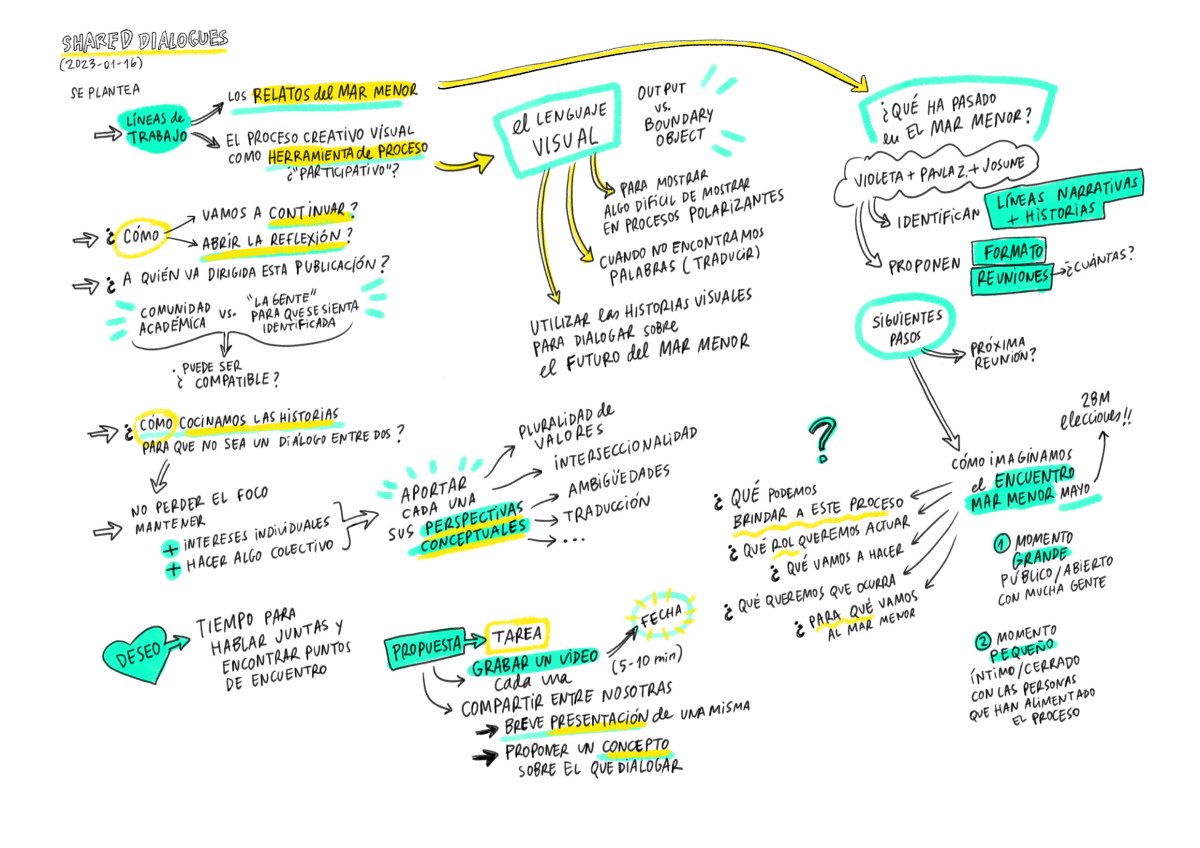
Shared Dialogues / Diálogos Compartidos is a transdisciplinary project that explored participatory and artistic tools for collectively reflecting on ecological loss and environmental conflict, using the eutrophication of the Mar Menor lagoon as its ground. Between 2021 and 2023, a women team of researchers and the visual artist Josune Urrutia turned three years of fieldwork in the Mar Menor into a participatory process that moved from listening, to dialogue, to collective storytelling.
A process of translation
**Thinking-with some concepts.** Our first encounters as a team were devoted to explore some concepts that could guide our co-creation of visual stories. We discussed about intersectionality, ambiguity and liminality, translation, the non-human and its representation.
**Co-creating the visual stories.** We crafted a method for translating qualitative data from interviews and workshops transcripts first to written scripts then to visual stories. We decided that it was important to convey the wide diversity of experiences around the lagoon’s eutrophication existing in the territory. We thus selected a set of individual characters and a set of dialogues between local actors we wanted to share. Then we crafted their written stories and then Josune added her artistic magic to convert them into individual visual pieces.
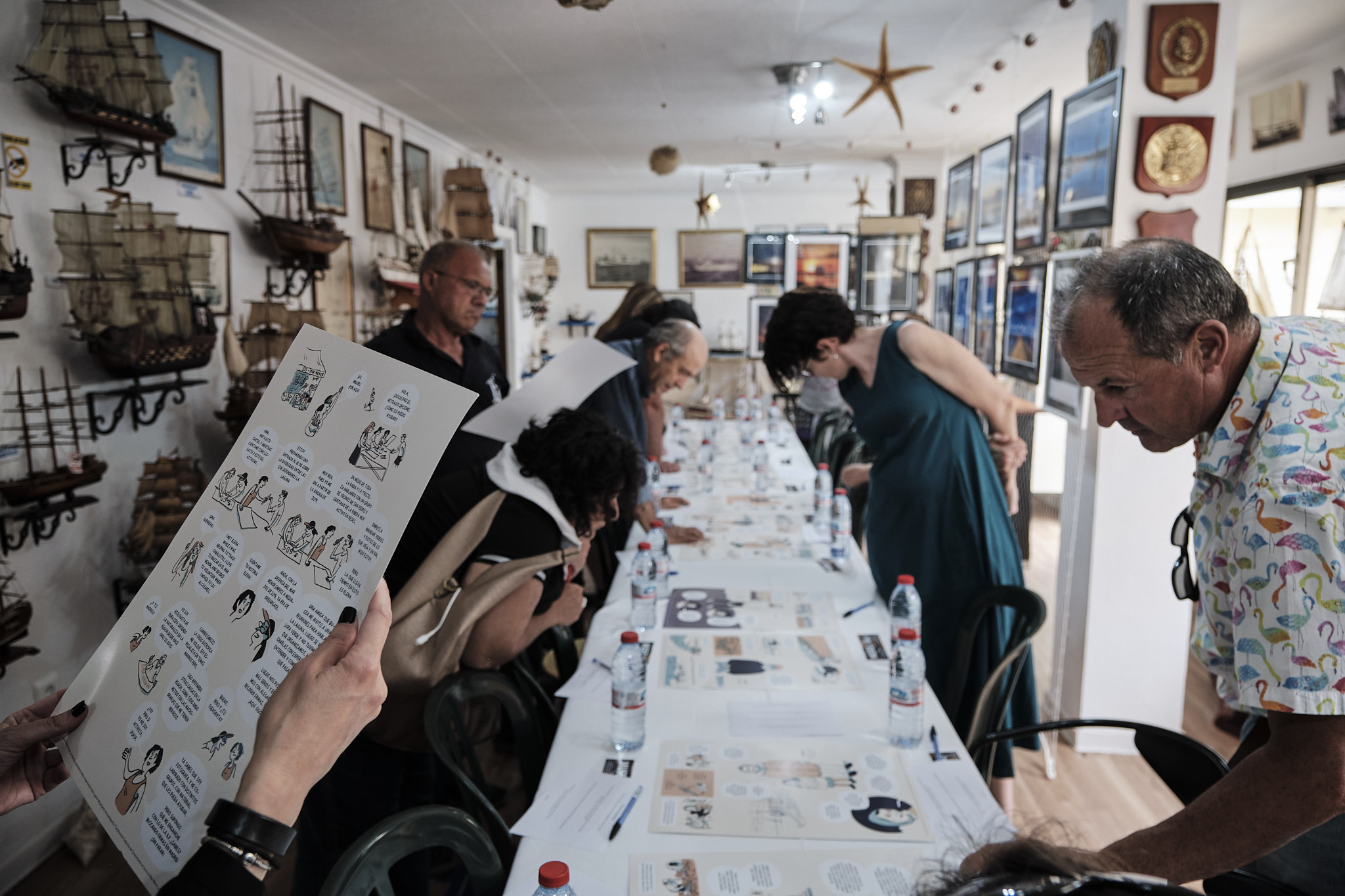
**Sharing and refining the stories.** In collaboration with artists Arkaitz Saiz & Raquel Meyers [A R K A M E Y E R S], we organised the exhibition ‘Boria and Other Stories about the Mar Menor’, on view from April 27 to May 12, 2023, at the Puertas de Castilla Cultural Center in Murcia. On May 3rd, we held a workshop with local actors after a wonderful navigation experience with Turismo Marinero Murcia (https://www.turismomarineromurcia.com/). Participants reviewed the visual stories, provided feedback and suggested few more stories to include. That interaction help us understood the power of visual records for sparking deep dialogues.
**Compiling the stories in the Ecotone(s) publication.** We developed two more stories (one on the blue crab and another on the role of public administrations). Then reflected on how to weive such a collection together. This reflection led us to the idea of “ecotones” — the transition zones where different ecosystems overlap. We used it as a metaphor for the places where communities, and the stories they tell about the Mar Menor, meet and rub against each other.
What it produced
The final output was a set of twenty illustrated stories, later compiled into the book Ecotone(s) [see the outreach page for a full overview].
Video of the final seminar “Beyond written words” (in Spanish), where the Econote(s) was presented together with the experiences of research through visual arts of Federica Ravera & Martina Manyà, Carla Boserman, Maria Ordoñez-Cruz and Andrea Cagua.
Presentation about the project (in Spanish)
Credits
*Diálogos Compartidos* was a collective effort by (in no particular order): Paula Andrea Zuluaga-Guerra, Violeta Cabello Villarejo, Marcela Brugnach, Maria Mancilla Garcia, Paula Novo, and Josune Urrutia Asua.
– Participatory research in the Mar Menor and Campo de Cartagena: Paula Andrea Zuluaga-Guerra and Violeta Cabello Villarejo.
– Project design and co-creation of content and visual stories: all six team members above.
– Project management: Paula Novo.
– Graphic design, layout and illustration: Josune Urrutia Asua.
This work was funded by the UK Government’s Research England Policy Support Fund and Participatory Research Fund (2022–23), and recevied support from Spain’s Ministerio de Ciencia e Innovación through the Juan de la Cierva programme (MCIN/AEI/10.13039/501100011033) and the Ramón y Cajal programme (RYC2021-031626-I); the María de Maeztu excellence accreditation programme 2023–2027 (CEX2021-001201-M); the Basque Government’s BERC 2022–2025 programme; and the European Commission’s Horizon 2020 Marie Skłodowska-Curie Innovative Training Network NEWAVE – Next Water Governance (grant agreement No. 861509).

