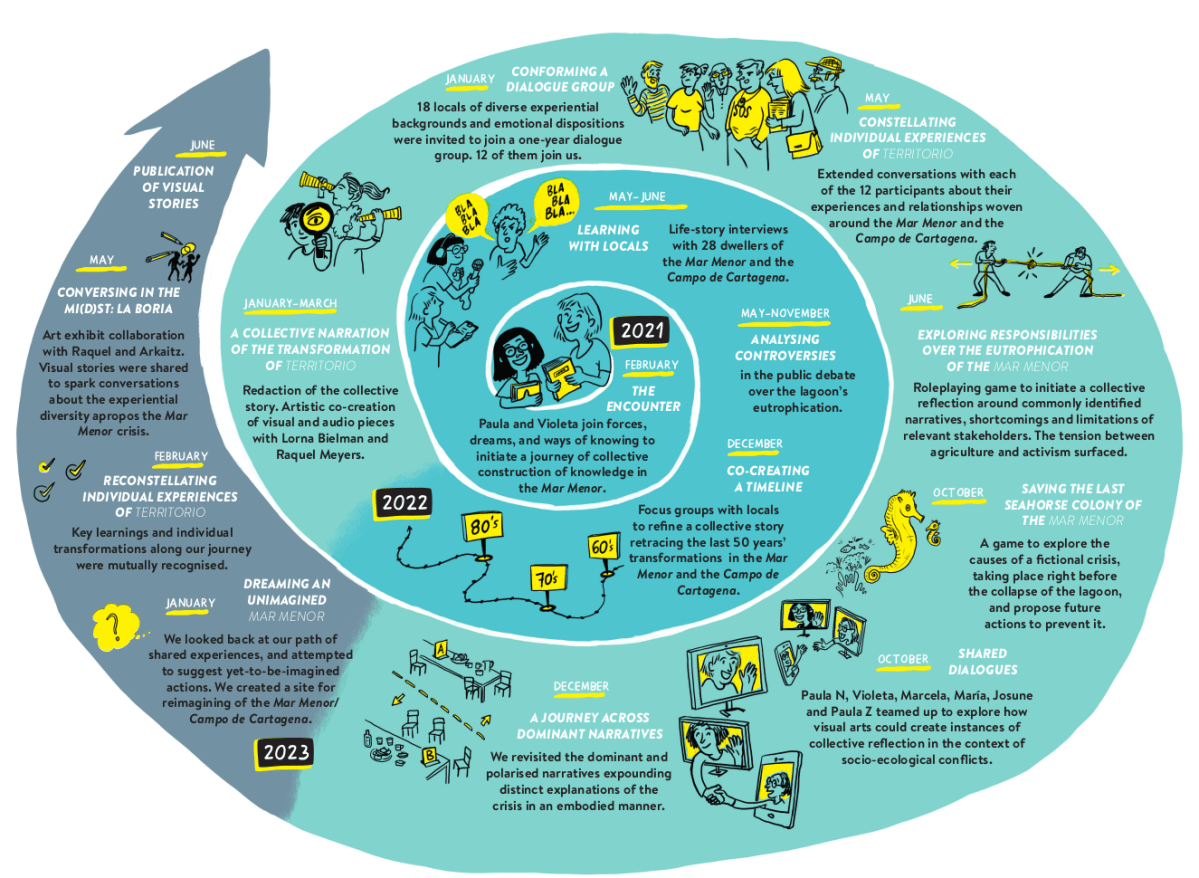
Illustration: Josune Urrutia
Based on my research “Knowledge co-production for the governance of wicked water–food–ecosystem problems” supported by Juan de la Cierva (IJC2019-038847-I/AEI/10.13039/501100011033) and Ramón y Cajal Fellowships (RYC2021-031626-I)
Before the Mar Menor: from models to facilitation
I didn’t start out studying emotions, conflict, or relations. My training was in environmental science and hydrology. Both my PhD in Human Geography with Leandro del Moral at the University of Seville and my first postdoc at ICTA-UAB largely focused on water governance, combining the analysis of water metabolism and of policies and narratives of water management in semiarid lands. What actually pushed me to change direction wasn’t a new theory but a new practice: facilitation. Through my training with the Spanish Institute for Facilitation and Change, I learned to hold group processes and participatory practice. I found a register of knowledge, felt and relational, that my previous training had no way to capture. By the end of 2020, I was, in my own words at the time, “a quantitative and mixed-methods researcher” looking for an opportunity that would let me become something else. And the Mar Menor arrived.
2021: choosing the Mar Menor as a living lab
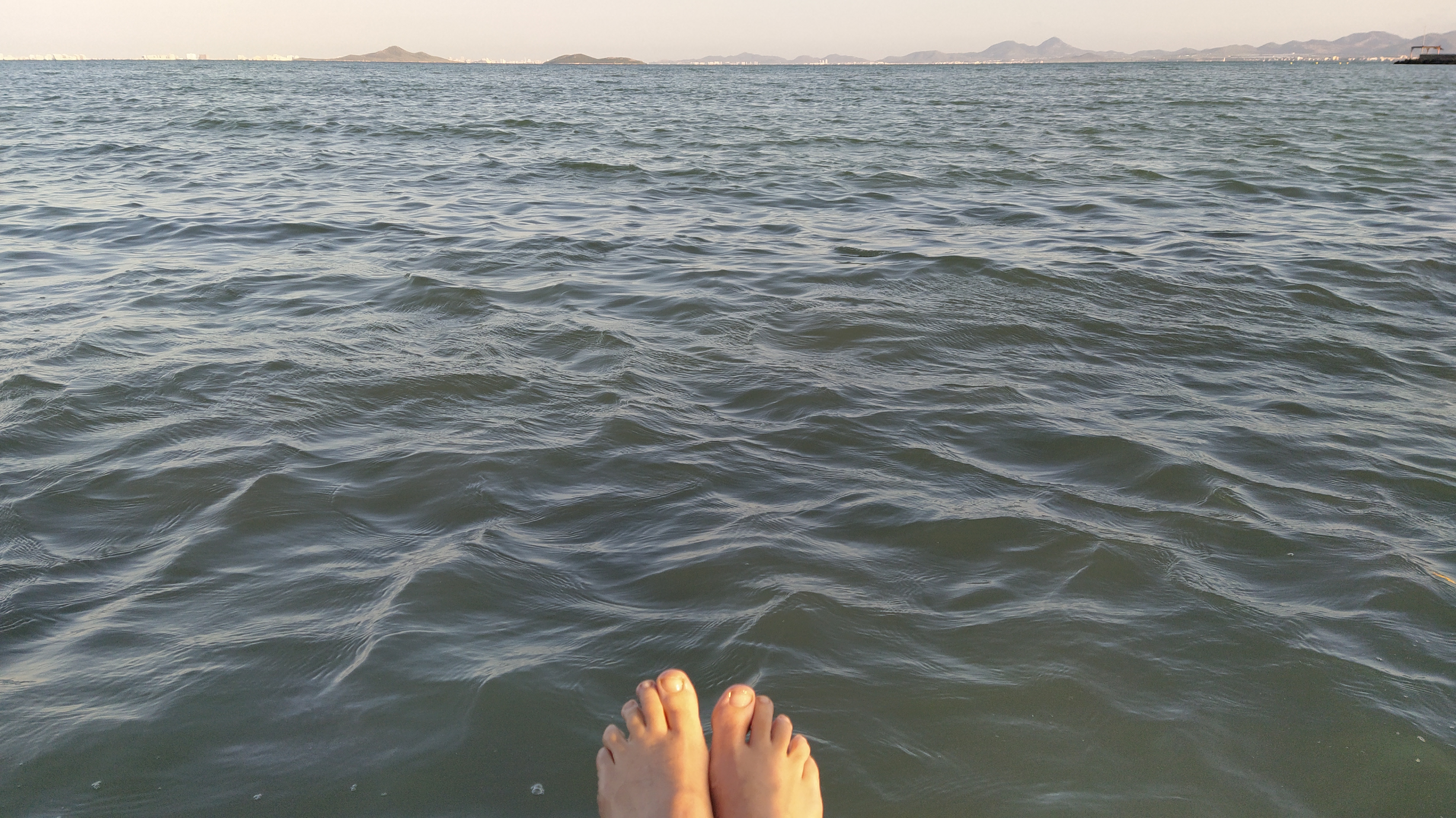
In January 2021 I joined BC3 as a Juan de la Cierva fellow under the supervision of Marcela Brugnach, and I chose the Mar Menor — Spain’s largest coastal lagoon, one of its most dramatic cases of ecological degradation due to eutrophication at the time a success story due to its recent recognition as legal subject — as the ground for a deliberate methodological reinvention. The research project I designed that year, “Wicked knowledge co-production: the Mar Menor case study,” set out an explicit hypothesis: that knowledge co-production on wicked social-ecological problems has to attend not only to facts and institutions, but to ambiguity, power asymmetries, and “the emotional configurations associated with ecological degradation and conflicts between actors.”
That sentence, written before I had done a single interview nor read anything about emotions theory, turned out to define the next five years of my work. I remember framing the Mar Menor explicitly as a “Living Lab” — a place to test, in real conditions, whether attending to feeling and relationship could do analytical work that a purely institutional or quantitative account could not. My first week of fieldwork I met Paula Zuluaga, working on the NEWAVE project, and we decided to join dreams and forces in a collaborative research that would last for more than three years.
2021: understanding the Mar Menor as a social problem
Apart from my preliminary hypothesis, I traveled light to the salty lagoon. Paula and I followed a mostly inductive participatory research approach, working in dialogue with the Mar Menor territory and its inhabitants in order to define each research stage. In recognition of the limited social science analysis of the eutrophication problem, we started with a societal diagnosis in a two-fold strategy. I delved into the scientific-technical literature to examine dominant narratives and found they were polarizing partly due to uncertainty and contested knowledge claims over the sources of nutrients reaching the lagoon, the water flows through which nutrients traveled or the sustainability of existing farming activities.
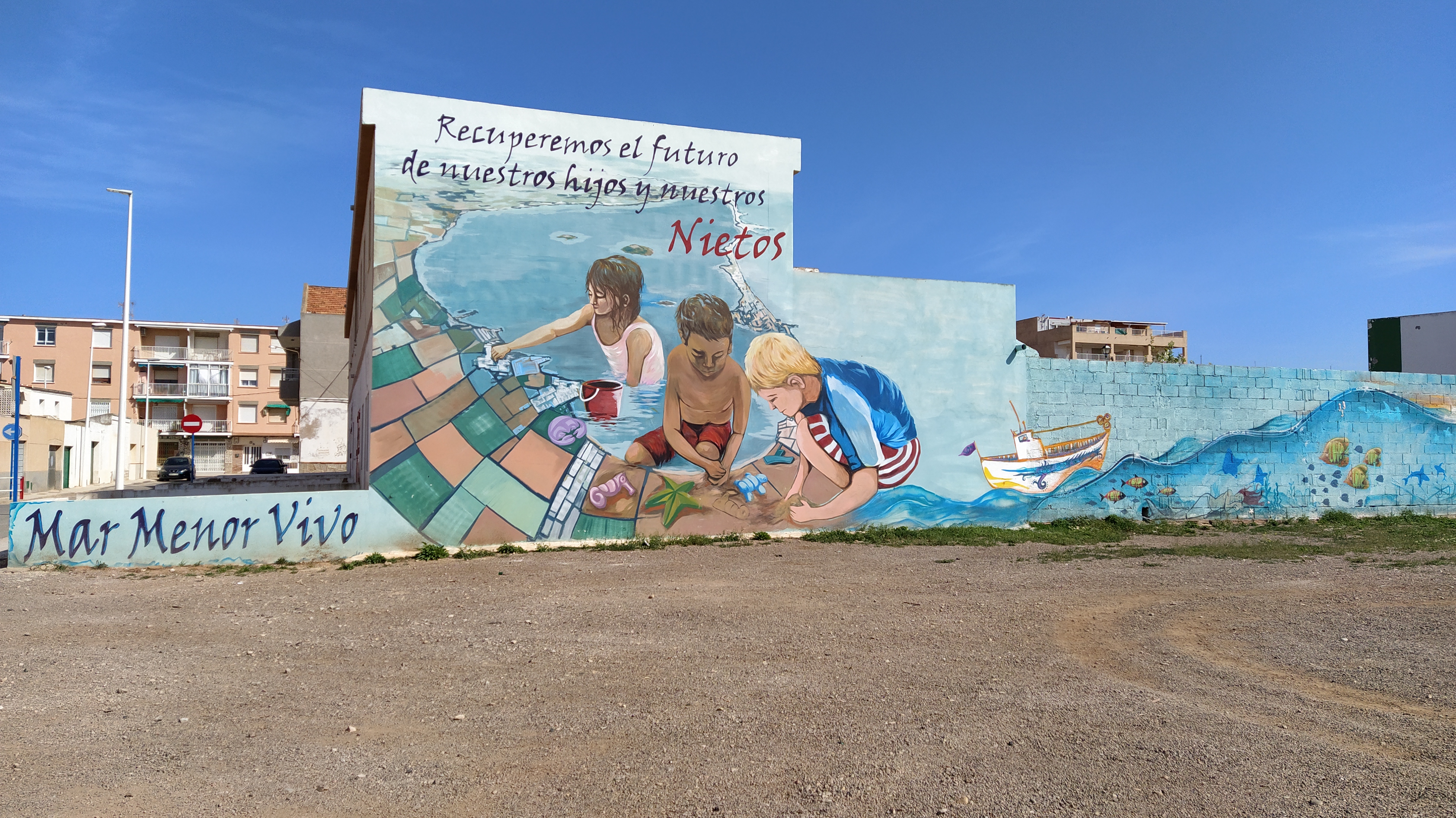
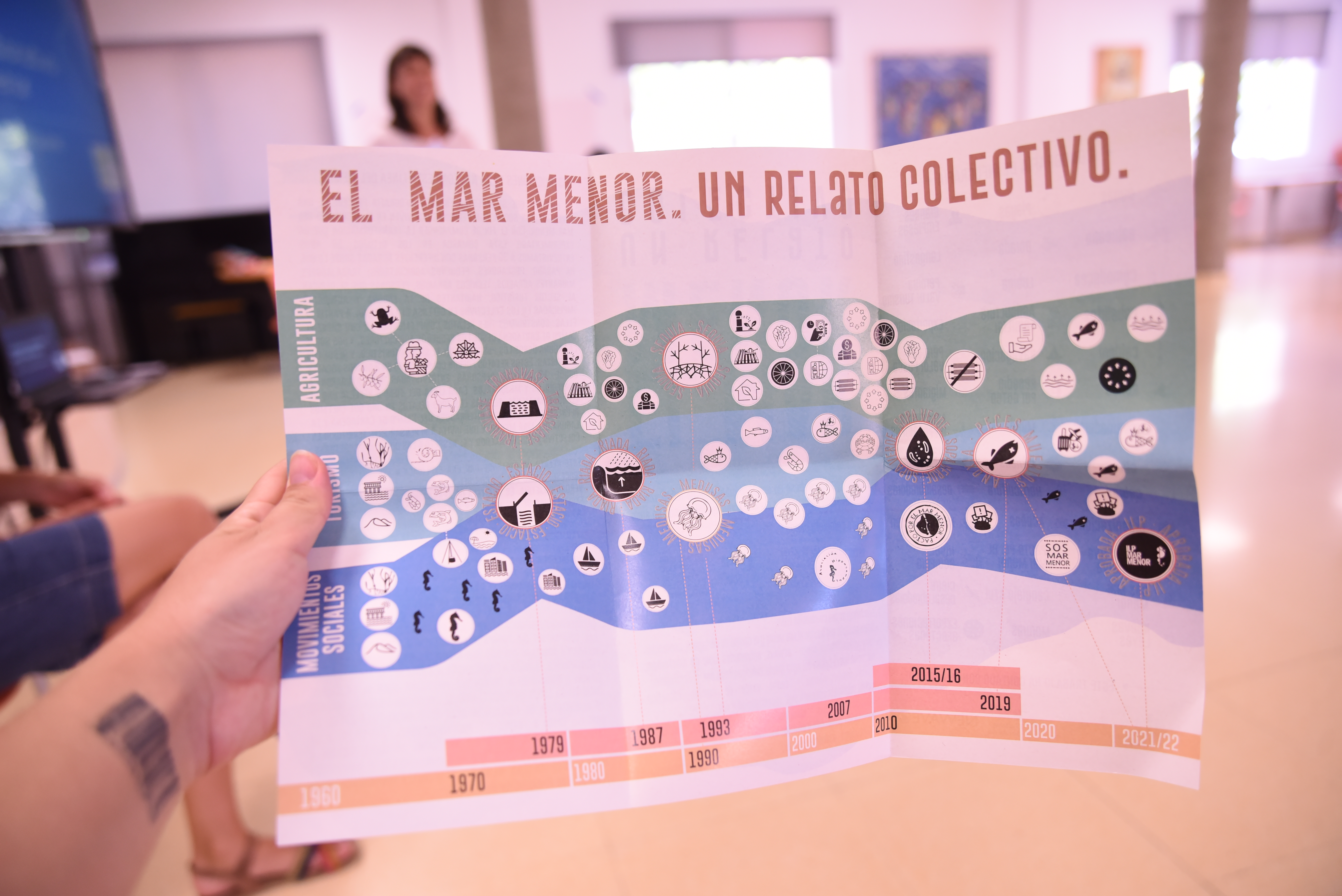
Paula traveled around the Mar Menor and its surrounding agricultural area, Campo de Cartagena, recording life-story interviews of 28 people describing the transformations of this territory over the last 50 years. Based on the interviews and later sectoral focus groups with farmers, lagoon activists, fishermen, and tourist sector, we wrote and recorded a collective piece describing the intertwined story of transformations along the land-see continuum. This worked helped us understand the deep affective charge of the lagoon’s crisis and the associated sociopolitical conflict had for local inhabitants.
2022-23: co-creating a T-Lab and visual stories
Following our preliminary research, and after many reflections, we decided to embark on a journey of collective inquiry inviting people holding polarized positions over the causes and solutions to the Mar Menor eutrophication problem. We invited 18 of those people, directly or indirectly connected to the territory. 12 of them agreed to participate, 8 in the entire process and 6 partially. They included fishermen, farmers, philosophy and art teachers, an agricultural technician, biologists with expert knowledge of the lagoon, and some activists. No public officials or social representatives who are already visible in the media were invited because we prioritized invisibilized voices.
We initially framed it under the lenses of “Transformation Labs” (T-Labs), learning from an impressive process in the Xochimilco wetland in Mexico City, also subject of ecological degradation and social conflict, led by colleagues at UNAM. We developed initial interviews with each participant, four workshops altogether and final interviews with those participated more intensely and could speak of what had they learnt in it. Our aim with the T-Lab was to unpack controversial topics and marginalized problems in the Mar Menor territory, such as the precarious conditions of immigrant workers in the fields. We experimented with a panoply of participatory methods (role and performative games, embodied and sensing exercises, polarized conversations, future dreaming,…). Some worked for opening conversations, others sparked contestation and tense moments. In sum, it was a rich, intense, unique experience, full of challenges and learning.
In 2022, I was granted a Ramón y Cajal Fellow, starting Jan 23, enabling me to consolidate this research line for five more years. My colleague Paula Novo obtained funding for the Shared Dialogues project to work with illustrator Josune Urrutia and an amazing group of women researchers translating years of fieldwork into a different register entirely: twenty visual stories about the Mar Menor, refined in a workshop with local actors, later compiled into the book Ecotono(s), co-edited with contributing authors and eventually translated into English and French.
2024-2025: coming to theory
By 2024 I was back on my desk with a great volume of transcripts, pictures, audio and video records, plus an autoetnographic diary I had kept all along. I had no clear idea about how to analyse all that material. I started re-reading papers from Marcela Brugnach on relational approaches to knowledge co-production, and a battery of feminist authors working around posthumanisms, new materialisms, ethics of care, affect and emotions. Slowly, I crafted my first sole author paper “Tales on co-response-ability in times of environmental polarization,” published in Ecology and Society as part of a special issue entitled “The co-production of conflicts in environmental sustainability: concepts, methods and ethics“. This paper is a personal account of the co-creation process that traces a pattern across everything I’d gathered: people around the Mar Menor were not short of facts, or even of concern for the lagoon. What kept them stuck in division was something more relational — a dynamic in which acknowledging responsibility felt like accepting blame, so almost everyone, understandably, avoided it. I called this the “responsibility trap” and dug deeper on what during our process had helped shifting it to a more “co-response-able” pattern -inspired in Donna Haraway: a relational, affective way of sharing responsibility that doesn’t require anyone to lose face first.
That paper marked a genuine turn in how I described my own work now evolving into “a more theoretical endeavour,” reading environmental conflict through relational and affective lenses. During a research stay at the Stockholm Resilience Centre in spring 2025 hosted by my dear María Mancilla, with my partner with Xabier Barandiaran we began asking what a genuinely social-ecological account of affect could look like. We found answers in Jan Slaby and colleagues theory of affective relationality and drew on it for writting in “Socialecological affective arrangements (SEAA): diving with a small sea of many seas”, currently under review. My questions became: what do different people feel when a place they are deeply attached to is dying, and what how those affects entangle with each other and with knowledge narratives, shaping socialecological dynamics? We developed a method we called the “mapparatus” to map affects and emotions as relations between socialecological entities.
Over these years I built an intimate, ongoing collaboration with Juan Manuel Zaragoza and the Environmental Humanities collective- ehColab at the University of Murcia. Juanma led the Ant-Mental Health project there — on climate crisis, mental health, and wellbeing in the Anthropocene — and within it, in January 2025, invited me to facilitate a participatory workshop within the seminar “Speculative Natures,” exploring what it means to grant ecosystems legal personhood, echoing the Mar Menor’s own legal-personhood status. That same collaboration produced a co-authored book chapter, “A citizen assembly for transitioning the Mar Menor?” (with Nicolás Gutierrez and Alba Ballester), simulating a citizen assembly — with half the participants voicing human and more-than-human roles — for the edited volume The History of Environmental Degradation in Mar Menor: A Case Study, which Juanma co-edited.
2026: from one lagoon to a research program
The Mar Menor has given me an amazing network of collaborators, a new conceptual repertoire and a methodological palette for transformative research in conflictive settings. 2026 is when I try to turn it into a research program. I am working on an Ikerbasque — maybe ERC? — proposal entitled AFFEKTA — Affective Knowledge: Advancing Sustainability Transformations Amid Discord” setting out a five-year plan (2027–2031) to test whether “affective knowledge” (a term coined by Andrea Nightingale) can help navigate environmental conflicts more broadly, extending the SEAA and co-respons-ability frameworks beyond the Mar Menor to new cases.
Looking back, the line from my first Mar Menor fieldnotes to AFFEKTA is a single question asked with increasing precision: not “what is wrong here,” but “what would it take for people to feel able to respond together to polarized socialecological problems”. Everything on this page — the papers, the images, the workshops — is an attempt to answer it.
—
Selected publications from this research line
Cabello, V., & Brugnach, M. (2023). Whose waters, whose nutrients? Knowledge, uncertainty, and controversy over eutrophication in the Mar Menor. *Ambio*, 52, 1112–1124.
Cabello, V. (2024). Tales on co-response-ability in times of environmental polarization. *Ecology and Society*, 29(4), 22.
Cabello, V., & Serrano, E. (2024). Abandono y recomposición más allá de los paisajes capitalocénicos [book chapter]. [ ] add full book/editor details.
Gutierrez, N., Ballester, A., & Cabello, V. (2025). A citizen assembly for transitioning the Mar Menor? In J. M. Zaragoza, D. Soto Carrasco, & M. Canteros (Eds.), *The History of Environmental Degradation in Mar Menor: A Case Study*. Routledge. [ ] add page numbers once the final typeset version is out.
Cabello, V., Barandiaran, X.E., González-Mon, B., Zaragoza, J.M., Siqueiros, J.M., & Brugnach, M. (preprint, under review). Socialecological affective arrangements: diving with a small sea of many seas.
Mancilla García, M., V. Cabello Villarejo. 2024. Tres fabulaciones para el Mar Menor: Una perspectiva relacional y procesual sobre los conflictos hídricos para generar transiciones respons-ables. Pensamiento al Margen: revista de ideas políticas. 20(6). https://pensamientoalmargen.com/20/06_PaM20_Mancilla.pdf
González-Mon, B., Cabello, V., Jiménez-Aceituno, A., Mancilla García, M., Castro, A. J., López-Rodríguez, M. D., Moore, M.-L., & Schlüter, M. (2025). Unstable bridges—Exploring the possibilities for “in between” spaces amidst divergent narratives in environmental governance. Sustainability Science. https://doi.org/10.1007/s11625-025-01772-x
14/06/23 Interview in the “El punto azul” section of the Spanish National Radio show “Las tardes”, with Patricia Fernández de Lis (in Spanish).
https://www.rtve.es/play/audios/las-tardes-de-rne/primera-hora-14-06-23/6914082/

